What Is an Agent-Friendly Company? How to Prepare for AI Agents (2026)

Software discovery is changing faster than many of us realize. For years, the common practice was to compare software manually. People searched online, booked demos, reviewed documentation, asked peers for recommendations, and evaluated vendors through lengthy procurement cycles. That model is now evolving as AI agents begin assisting with research, comparisons, onboarding recommendations, and vendor analysis.
This shift is creating a new competitive advantage for vendors that recognize the importance of becoming agent-friendly.
In the near future, software decisions will increasingly be made by autonomous systems that evaluate APIs, pricing, onboarding, integrations, and technical documentation before a human conversation begins. As Gartner projects massive agent-mediated B2B purchasing, vendors with machine-readable metadata and API documentation will have an advantage in discoverability, adoption, and long-term growth.
This transition isn't just about better automation; it represents a broader change in how software is evaluated, recommended, and trusted across digital ecosystems.
What Does It Mean To Be Agent-Ready?
An organization becomes agent ready when its products, interfaces, documentation, and operational standards are understandable to both people and software-driven decision engines.
Traditional websites were built primarily for humans. Modern software environments must also support machine interpretation.
That means systems should expose structured information clearly enough for software assistants to:
- Compare vendors
- Understand integration requirements
- Analyze pricing models
- Verify technical compatibility
- Navigate workflow steps
- Assess reliability signals
- Interpret authorization requirements
- Recommend solutions with more confidence
The same way search optimization reshaped digital publishing, software discoverability is beginning to evolve toward machine-readable evaluation.
Curious which software vendors are already adapting to AI-driven evaluation? Proven’s Agent Friendly research project ranks companies based on factors like APIs, documentation, pricing transparency, and discoverability.
Why AI-Driven Procurement Is Emerging
Modern enterprises increasingly rely on automation to reduce the burden of manual research. Instead of spending weeks in the evaluation phase, future procurement systems may delegate large portions of their analysis to enterprise AI agents.
These systems can rapidly:
- Review APIs
- Analyze data
- Compare infrastructure maturity
- Evaluate compliance standards
- Review security controls
- Examine pricing transparency
- Assess onboarding friction
- Detect fraud patterns
- Validate integration compatibility
This evolution changes how buyer journeys begin.
Instead of a person searching through dozens of pages, intelligent evaluation layers may filter vendors automatically before a final conversation ever occurs.
As a result, companies that improve machine accessibility early may gain a meaningful distribution advantage.

How AI Agents Evaluate Software Vendors
Most modern evaluation systems focus on structured interpretation rather than visual branding alone. When agents work through software comparisons, they prioritize clarity, accessibility, interoperability, and reliability.
Several areas matter most.
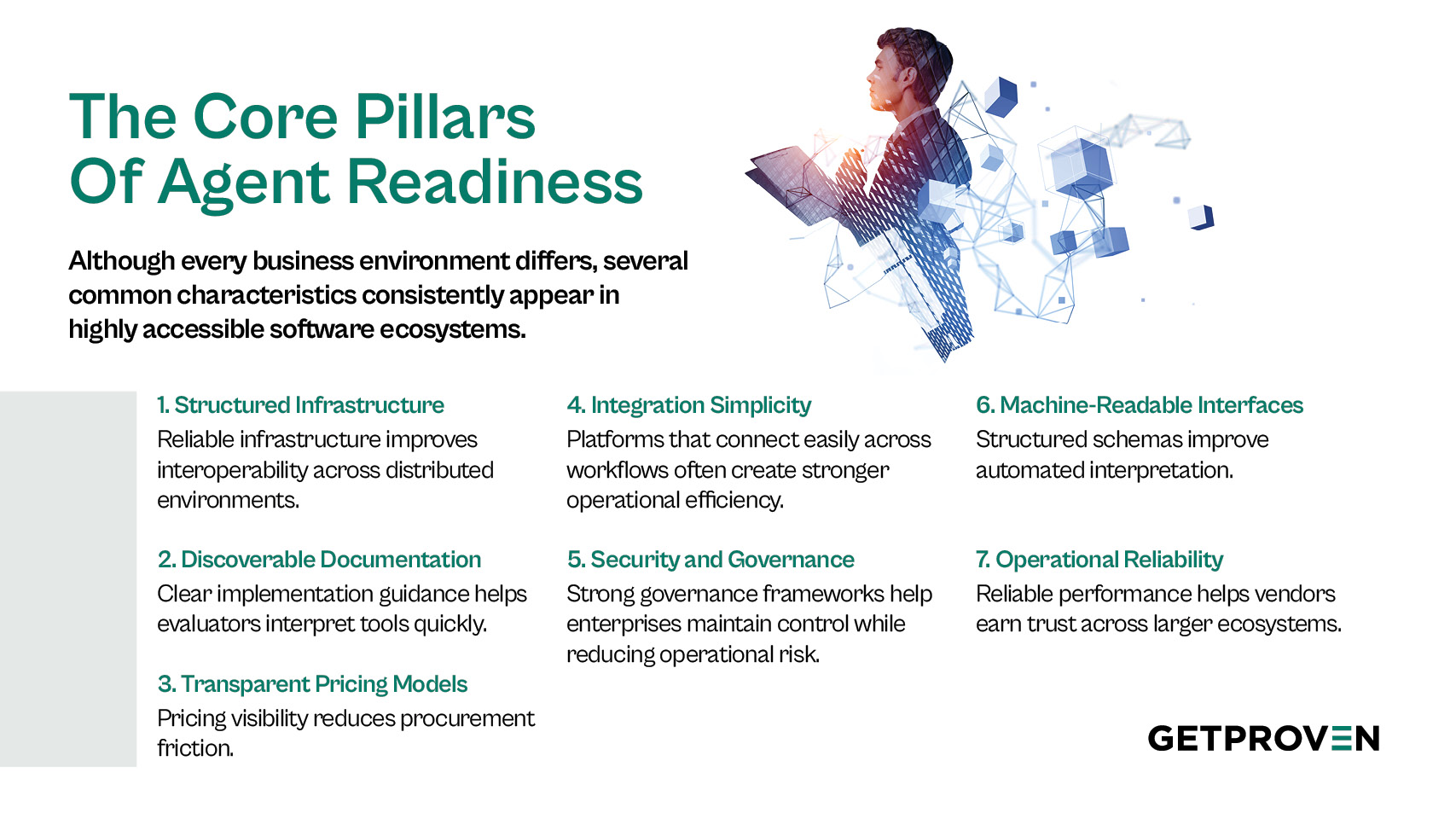
1) API Accessibility
Strong APIs allow platforms to connect efficiently with enterprise systems and external services.
Accessible interfaces reduce implementation friction while improving automation opportunities.
2) Structured Documentation
Technical guidance should provide clear context, searchable references, implementation examples, and concise explanations.
Well-organized documentation improves the ability of software evaluators to understand integrations without requiring excessive human oversight.
3) Transparent Pricing
Opaque pricing slows down evaluation. Platforms that clearly present packages, usage limits, implementation requirements, and support structures are easier to evaluate programmatically.
4) Authentication And Permissions
Modern software must establish secure access controls while minimizing unnecessary onboarding barriers. Clear authorization standards help external evaluators understand operational boundaries and trust requirements.
5) Operational Reliability
Evaluation layers increasingly analyze uptime signals, governance maturity, compliance readiness, and monitoring capabilities before recommending a platform.
Why Are Traditional SaaS Evaluation Models Breaking Down?
Many modern software platforms were built for a world where humans handled every stage of vendor evaluation manually. Buyers sat through demos, booked discovery calls, reviewed pricing sheets, and relied heavily on sales conversations to understand whether a platform was a good fit.
That model breaks down when software is being evaluated programmatically.
A surprising number of vendors still make critical information difficult to access. Pricing is often hidden behind forms. Documentation can feel fragmented or outdated. APIs may exist, but without enough structure or clarity for automated evaluation systems to interpret them efficiently. Even basic onboarding information is frequently buried across disconnected pages.
These issues create friction in environments where software must be analyzed quickly and reliably.
For large enterprises managing increasingly complex workflows, accessibility and interoperability are no longer minor operational concerns. They are becoming competitive differentiators. A platform that is difficult to interpret programmatically may eventually become difficult to recommend, integrate, or trust within AI-driven procurement environments.
This is one reason why the idea of agent readiness is gaining attention across the SaaS industry.
Organizations are beginning to recognize that discoverability now extends beyond search engines and human buyers. Software also needs to be understandable to systems that evaluate vendors autonomously.
Proven’s Agent Friendly research initiative explores how software vendors perform across these emerging standards, including documentation quality, API accessibility, pricing transparency, and machine-readable discoverability.
How to prepare your company for AI Agents
Becoming more accessible to AI-driven evaluation does not require rebuilding an entire platform from the ground up. In most cases, the companies making the strongest progress are simply reducing friction.
They are improving documentation, simplifying onboarding, clarifying pricing structures, strengthening governance, and making integrations easier to understand. These changes may seem operational on the surface, but together they significantly improve how both humans and intelligent systems evaluate software.
Documentation plays a particularly important role. Clear technical guidance gives evaluators the context needed to understand implementation requirements, compatibility, and operational expectations without unnecessary delays. The same is true for APIs and integrations. Systems that connect effortlessly with internal tools and external services are easier to analyze, deploy, and scale.
Transparency also matters.
Software buyers increasingly expect visibility into pricing models, packaging structures, support levels, compliance readiness, and implementation requirements before they commit to deeper conversations. As AI-assisted procurement becomes more common, opaque systems may create unnecessary friction during automated evaluation.
Operational maturity is equally important. Enterprises want confidence that platforms can support governance standards, maintain security expectations, and provide reliable monitoring capabilities across evolving infrastructure environments.
At the same time, even highly automated ecosystems will continue requiring human review in sensitive or high-risk scenarios. The goal is not to remove people from decision-making entirely. Instead, the strongest platforms will support intelligent automation while still allowing appropriate human oversight and control.

The Future Of Software Discovery
As agentic AI continues evolving, software discovery may depend less on traditional marketing tactics and more on structured accessibility. That shift has implications far beyond SEO.
Product design, onboarding architecture, APIs, governance frameworks, interoperability standards, and operational transparency will increasingly shape how future systems evaluate vendors. In many cases, intelligent evaluation layers may begin filtering potential platforms before a buyer ever visits a website or speaks with a sales representative.
This creates a fundamentally different environment for software companies. Instead of optimizing purely for human attention, vendors may also need to optimize for machine interpretation. Systems that expose clear data, structured documentation, transparent pricing, and reliable integration standards will likely have an advantage as autonomous evaluation becomes more common.
Some organizations are already experimenting with MCP server environments, orchestration layers, Claude code integrations, and other advanced tools designed to streamline software analysis and operational coordination.
As these ecosystems mature, discoverability standards will continue evolving alongside them.
Agent-Friendly Companies Will Have A Competitive Advantage
The future is here, and agents are beginning to handle many evaluation tasks, reducing friction and reclaiming time for busy teams and decision-makers. The vendors that succeed in this new agentic environment will be those that rebuild their digital real estate to make it easier for agents to assess the value of their solutions.
Beyond technical infrastructure, this is also about procurement efficiency, onboarding speed, implementation confidence, and operational visibility for both buyers and vendors. In many ways, this next era of software competition will likely be shaped more by accessibility than by marketing prowess and public attention.
Platforms that simplify workflows, strengthen governance, improve interoperability, and support safe automation will likely outperform fragmented systems that remain difficult to evaluate programmatically.
As AI-driven procurement expands across the global software market, businesses that prepare early may establish a stronger position long before these standards become mainstream.
To better understand how software vendors are preparing for this transition, Proven’s Agent-Friendly research initiative evaluates platforms against emerging standards such as API accessibility, interoperability, pricing transparency, and machine-readable discoverability.