How Banks Can Compete With Fintechs Without Becoming Fintech
Banks aren't losing relevance overnight, but they are facing increasing pressure to remain competitive as fintech companies reshape consumer expectations.
In 2026, most effective financial institutions aren't trying to replicate fintech models. Instead, they're innovating hard to combine their existing strengths with modern capabilities.
Key approaches include:
- Focusing on customer relationships and trust as core differentiators
- Improving digital banking experiences and mobile apps
- Extending products and services through partnerships and ecosystems
- Using customer data to deliver more relevant and personalized experiences
- Strengthening customer engagement to remain central in customers’ financial lives
Banks that take this approach are better positioned to stay competitive, improve customer retention, and grow market share over time.

Where Do Fintech Actually Compete?
Much of the conversation around fintech disruption suggests that banks are being replaced. In practice, the shift is more specific.
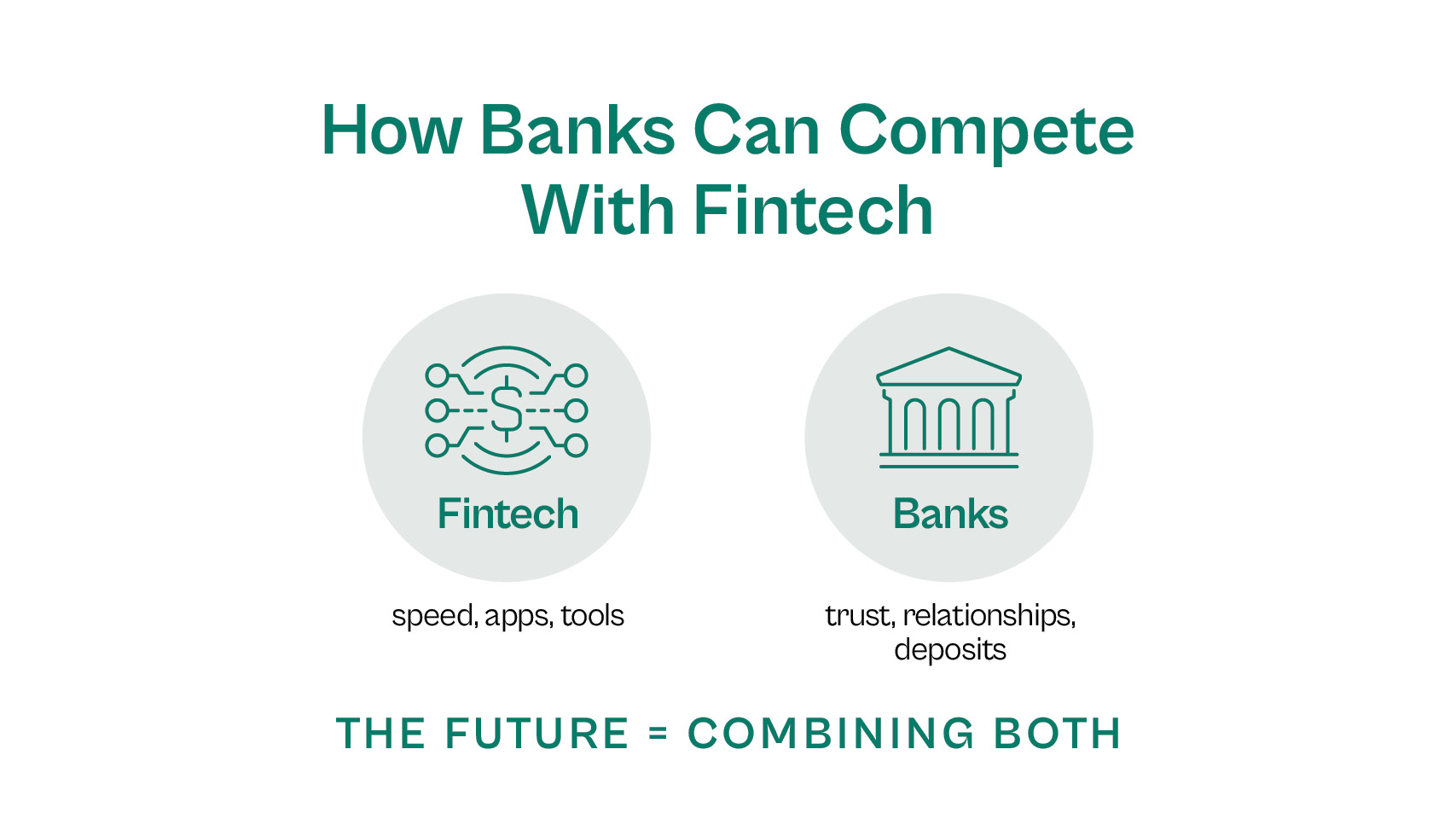
Fintech companies tend to compete in areas where speed, simplicity, and user experience matter most. This includes payments, onboarding, and the ability to manage money through intuitive digital interfaces. Mobile apps and digital banking tools have made it easier for consumers and businesses to access financial services without relying entirely on a traditional bank.
For many customers, this results in a fragmented experience. A checking account may still sit with their old bank, while other financial activities are handled through different platforms. Over time, this distribution of activity can shift how customers perceive their primary financial provider.
The real concern then is less about being replaced and more an issue of relevance. Because whoever is connected to the daily financial life of the customer is the most relevant and valued relationship
What Banks Still Do Better
Despite these shifts, banks continue to play a central role in the financial services industry.
Traditional banks, including community banks, national banks, and credit unions, have advantages that fintech companies often cannot easily replicate. These include deposit relationships, lending capabilities, regulatory standing, and long-standing customer relationships built on trust.
For many customers, their bank remains the place where direct deposit is received, savings goals are managed, and larger financial decisions are made. These are foundational elements of financial well being that extend beyond convenience.
Community financial institutions, in particular, maintain strong ties to the communities they serve. Through community events, local engagement, and ongoing support, they build trust in ways that digital-first providers often cannot.
These strengths are essential. The challenge is ensuring they remain visible and relevant in a changing market, especially in the eyes of the customer.
Why Does the Gap Exist?
The gap between banks and fintech is not simply about technology. It is shaped by how financial institutions operate.
Banks are responsible for managing risk, protecting customer data, and complying with regulatory expectations. These responsibilities influence how quickly new solutions can be introduced and how products and services are delivered.
At the same time, many banks rely on legacy systems that were not designed for rapid iteration. As a result, even when institutions recognize the need to improve customer experience, the path to implementation can be slow and complex.
This dynamic affects both large banks and community banks, though the constraints may differ in scale. Larger institutions may have more resources, but also more complexity. Smaller institutions may be more agile, but operate with tighter budgets and fewer internal teams.
The result is a gap in how quickly banks can respond to changing consumer expectations compared to fintech providers.
Why Trying to Act Like Fintech Doesn’t Work
In response to this gap, some banks attempt to replicate fintech models directly. This often leads to challenges.
Banks and fintech companies operate under different conditions. Fintech firms are typically focused on a narrow set of services, are digitally native, and can prioritize speed and user experience above all else. Banks, on the other hand, must balance innovation with stability, compliance, and long-term responsibility to customers.
Trying to mirror fintech behavior without adjusting for these differences can lead to fragmented solutions or initiatives that are difficult to sustain.
A more practical approach is to recognize that banks do not need to become fintech companies to remain competitive. Instead, they need to adapt how they deliver value within their existing structure.
A More Practical Way to Compete
Banks that compete effectively tend to focus on extending their capabilities rather than replacing them. This often involves combining internal strengths with external solutions. Instead of building every new feature, institutions can work with partners to offer additional services that align with their customers' needs.
This approach allows banks to expand their digital presence while maintaining focus on their core responsibilities. It also provides flexibility, enabling institutions to adjust their service offerings as market conditions evolve.
For example, a bank may enhance its customer experience by integrating tools that support payments, financial education, or money management without needing to build those systems entirely in-house.
Over time, this creates a more connected experience for customers while allowing the bank to remain central to their financial activities.

Competing Through Relevance And Outcomes Rather Than Features
In a crowded market, differentiation is less about offering more features and more about delivering relevant solutions.
Customers are not evaluating banks based on the number of products available. They are assessing how well those products fit into their financial lives. Personalized service, tailored solutions, and consistent support play a key role in shaping customer loyalty today. And when the bank can show how invested it is in enhancing its customers' daily lives, it is more likely to experience better retention.
Banks that focus on improving customer engagement are also more likely to maintain strong relationships with existing customers and attract new ones over time. Engagement today looks very different from what it was even a decade ago. The bank needs to understand its specific customer segments, identify their common needs and deliver more personalized experiences that reflect those needs.
When done well, this approach helps banks build trust and remain relevant even as competition increases.
Where Community Engagement Starts to Create Business Value
The most effective engagement strategies do more than keep the bank visible. They improve the quality of the relationship in ways that create measurable value over time.
Take financial education as one example. On the surface, it looks like a service for the customer. A webinar on cash flow, a guide to fraud protection, or practical advice on managing working capital helps a business owner make better decisions. But it also serves the institution. When a bank helps a customer understand a financial issue earlier, it often enters the conversation before that customer starts looking elsewhere for answers.
That matters because many small businesses do not begin with a product search. They begin with a problem. They're trying to manage uneven cash flow, reduce payment delays, evaluate financing, or make sense of a new stage of growth. If the bank is the place they turn to for clarity, the relationship deepens long before a formal product discussion begins.
The same pattern applies to other forms of value creation. A bank that offers relevant tools, timely guidance, or access to trusted services becomes more useful in the customer’s daily decision-making. That usefulness strengthens engagement, but it also improves the bank’s position commercially. It increases the likelihood that the customer keeps deposits with the institution, turns to it for lending when needs arise, and remains less vulnerable to offers from larger competitors.
At this point, engagement becomes more than a communication tactic; it becomes a way of shaping when and how the bank shows up in the customer’s business life. Institutions that understand this tend to compete more effectively because they are not only trying to capture attention. They are building a role in the customer’s ongoing financial decisions.
What This Looks Like in Practice
If you're reading this and thinking, " Our bank doesn't have this problem," you're not the only one to think that. For the most part, changes in customer behavior are slow and gradual, nearly impossible to spot until there's a tipping point.
A business client may still maintain a primary checking account with the bank and keep deposits there, but rely on other financial institutions for specific needs. Payment tools, expense management, or financing conversations may start happening elsewhere, often before the bank is even aware there is a need.
From the bank’s perspective, the relationship appears stable. From the customer’s perspective, the bank is no longer the first place they go when a question or challenge arises.
Internally, these patterns tend to surface through different signals. Relationship managers notice fewer meaningful conversations. Product teams see lower usage of certain services. Marketing efforts may generate activity, but not deeper interaction. None of these signals is dramatic on its own, but taken together, they point to a shift in how the customer is engaging with the bank.
At that point, the discussion inside the institution needs to change.
Instead of asking how to increase outreach or improve campaigns, the team should begin asking, "How do we become more relevant earlier in the customer’s decision-making process?"
That often leads back to the same set of considerations: what services are missing, how customers are solving problems today, and whether the bank is positioned to support those needs directly.
Some institutions respond by trying to build new capabilities internally. Others look at how to introduce solutions more quickly through partnerships. In both cases, the objective is the same: to re-establish the bank as a place where customers turn when financial decisions are being made, not just where transactions are processed.
Over time, even small changes in this direction can shift the relationship. When the bank becomes more involved in how customers think about their finances, it strengthens both engagement and long-term relevance.
Customer Expectations Big Banks vs. Community Banks
It is easy to assume that competing in today’s banking industry requires matching the capabilities of larger institutions or investing heavily in new technology. But in practice, customer expectations are not uniform across all types of banks.
Many customers choose community banks for reasons that go beyond convenience. They value responsiveness, familiarity, and the sense that their financial institution understands their situation. That level of trust is often built through consistent interactions and a deeper understanding of the customer, not through the number of features available in a mobile app.
That's why we often like to emphasize that for a community bank, customer engagement strategies should take on a more focused and human approach. Instead of trying to replicate the full range of services offered by larger banks, or even trying to turn into a fintech, your goal should be to reinforce the elements that already make you different and more preferred.
This does not mean technology is less important. It means that it should be applied with intention. Digital tools, financial literacy initiatives, or any other targeted services are only going to be effective if they are authentic to your institution's DNA and enhance the promise that attracted your customers in the first place.
Approached from this perspective, innovation becomes achievable and sustainable. Rather than attempting to be a copy of something you're seeing from a competitor, double down on enhancing the most relevant aspects of the solutions you offer today that your customers love, expand in the areas they have already been requesting or complaining about through technology and show both existing and new customers how technology is enabling you to do more in service to them.
In that context, the challenge is not to compete on scale, but to remain consistent in the areas where you already have a real advantage.
A Final Consideration for Banking Leaders
The pressure to compete with fintech often leads banks to focus on what they lack rather than what they already have.
In reality, most financial institutions are not starting from a position of weakness. They already hold the core elements that fintech companies spend years trying to build: trusted relationships, established customer bases, and a central role in how people manage their money.
The challenge is making them more visible and more useful in a changing environment.
For community banks in particular, this means leaning into what already works. When those strengths are combined with thoughtful use of technology and relevant solutions, they create a model that is difficult for larger competitors to match.
In that sense, competing with fintech is less about closing a gap and more about extending what the bank already does well into the areas where customers are spending more of their time.
Explore how banks are extending their strengths with curated tools and services that help them stay relevant in their customers’ daily financial lives. Learn more here.


Browse more topics from this article
Heading 1
Heading 2
Heading 3
Heading 4
Heading 5
Heading 6
Lorem ipsum dolor sit amet, consectetur adipiscing elit, sed do eiusmod tempor incididunt ut labore et dolore magna aliqua. Ut enim ad minim veniam, quis nostrud exercitation ullamco laboris nisi ut aliquip ex ea commodo consequat. Duis aute irure dolor in reprehenderit in voluptate velit esse cillum dolore eu fugiat nulla pariatur.
Block quote
Ordered list
- Item 1
- Item 2
- Item 3
Unordered list
- Item A
- Item B
- Item C
Bold text
Emphasis
Superscript
Subscript
Heading 1
Heading 2
Heading 3
Heading 4
Heading 5
Heading 6
Lorem ipsum dolor sit amet, consectetur adipiscing elit, sed do eiusmod tempor incididunt ut labore et dolore magna aliqua. Ut enim ad minim veniam, quis nostrud exercitation ullamco laboris nisi ut aliquip ex ea commodo consequat. Duis aute irure dolor in reprehenderit in voluptate velit esse cillum dolore eu fugiat nulla pariatur.
Block quote
Ordered list
- Item 1
- Item 2
- Item 3
Unordered list
- Item A
- Item B
- Item C
Bold text
Emphasis
Superscript
Subscript
Heading 1
Heading 2
Heading 3
Heading 4
Heading 5
Heading 6
Lorem ipsum dolor sit amet, consectetur adipiscing elit, sed do eiusmod tempor incididunt ut labore et dolore magna aliqua. Ut enim ad minim veniam, quis nostrud exercitation ullamco laboris nisi ut aliquip ex ea commodo consequat. Duis aute irure dolor in reprehenderit in voluptate velit esse cillum dolore eu fugiat nulla pariatur.
Block quote
Ordered list
- Item 1
- Item 2
- Item 3
Unordered list
- Item A
- Item B
- Item C
Bold text
Emphasis
Superscript
Subscript
Heading 1
Heading 2
Heading 3
Heading 4
Heading 5
Heading 6
Lorem ipsum dolor sit amet, consectetur adipiscing elit, sed do eiusmod tempor incididunt ut labore et dolore magna aliqua. Ut enim ad minim veniam, quis nostrud exercitation ullamco laboris nisi ut aliquip ex ea commodo consequat. Duis aute irure dolor in reprehenderit in voluptate velit esse cillum dolore eu fugiat nulla pariatur.
Block quote
Ordered list
- Item 1
- Item 2
- Item 3
Unordered list
- Item A
- Item B
- Item C
Bold text
Emphasis
Superscript
Subscript
Heading 1
Heading 2
Heading 3
Heading 4
Heading 5
Heading 6
Lorem ipsum dolor sit amet, consectetur adipiscing elit, sed do eiusmod tempor incididunt ut labore et dolore magna aliqua. Ut enim ad minim veniam, quis nostrud exercitation ullamco laboris nisi ut aliquip ex ea commodo consequat. Duis aute irure dolor in reprehenderit in voluptate velit esse cillum dolore eu fugiat nulla pariatur.
Block quote
Ordered list
- Item 1
- Item 2
- Item 3
Unordered list
- Item A
- Item B
- Item C
Bold text
Emphasis
Superscript
Subscript



.png)