
What Is a Business Banking Marketplace? A Practical Model for Community Banks

A business banking marketplace is a model in which a bank connects its clients to a curated set of tools, vendors, and services that help them run their businesses in addition to managing their money. For community banks, this approach builds on existing strengths like trust, local knowledge, and relationships, while extending their role into the day-to-day operations of the businesses they serve.

The Shift in How Community Banks Support Small Business Operations
For years, business banking was defined by a familiar set of offerings. Accounts, lending, and a range of financial products formed the foundation of how financial institutions served their clients. That model still matters, but it no longer reflects the full scope of what small business owners need today.
Running a business now involves a mix of tools and services that extend well beyond the bank. Payments, payroll, invoicing, and reporting often happen across multiple platforms. As a result, even when a bank remains a trusted financial partner, it is not always central to how the business operates.
This shift is especially important for community banks. These institutions are deeply rooted in their local market and have long played a crucial role in supporting local businesses and contributing to local economic development. But the way they deliver that support is evolving.
What a Business Banking Marketplace Actually Is
A business banking marketplace is a structured way for a bank to extend its role beyond traditional banking services by connecting customers with relevant solutions.
Instead of building every new capability internally, the bank curates a set of services that align with the financial needs of its clients. These may include tools for cash flow management, merchant services, or access to local partners that provide operational support.
The key difference is that the bank remains the central point of access. Customers do not have to search across multiple providers or piece together solutions on their own. Instead, they can discover and use services through a trusted relationship with their bank.
In this model, the bank is not just offering products. It is creating a more complete banking experience that reflects how businesses actually operate.
What Does This Look Like for a Community Bank?
For a community bank, the marketplace model often starts with what already exists.
Community banks offer strong relationships, a deep understanding of local needs, and an expert team that works closely with business owners. They are already connected to local organizations, service providers, and other businesses within their community.
A marketplace approach builds on this foundation.
For example, a bank might help small businesses access tools that simplify payments or introduce them to service providers who can support growth. It might connect a business owner with local partners who understand the same local market conditions or highlight solutions that help manage cash flow more effectively.
This isn't about replacing existing services such as savings accounts or small business loans. Those are still viable and a core part of the bank's services. Instead, we want to extend the bank's offering in a way that makes it feel more relevant to the customer's daily operations.
Over time, this can change how customers perceive the institution. The bank becomes more than a place to access capital. It becomes part of how businesses solve problems and make informed financial decisions.

Why This Model Fits Community Banks Particularly Well
The marketplace model aligns closely with how community banks already operate.
Community banks focus on long-term relationships and delivering personalized service. They are often more agile than larger institutions and better positioned to respond to local needs. Community bankers understand the unique challenges facing businesses in their area, from cash flow pressures to the realities of operating in underserved areas.
This local knowledge is a significant advantage.
While larger banks may offer scale, community banks offer context. They know the businesses, the industries, and the local economy in a way that allows them to provide tailored financial solutions. They also maintain close ties to community events and initiatives that contribute to local growth and economic stability.
A marketplace model allows community banks to extend this advantage. By connecting customers with relevant services, they can continue supporting small businesses in a way that feels consistent with their role as essential partners in the community.
Marketplace vs. Traditional Product Expansion
It is important to distinguish this model from traditional product expansion.
Historically, when banks identified a new need, the response was to build or add a product. That approach still applies in some cases, particularly for core offerings such as loans or deposit accounts.
However, not every customer innovation requires a new product. A business banking marketplace shifts the focus from building to connecting. Instead of asking how to develop every solution internally, the bank evaluates how to offer solutions that already exist in a way that is accessible and relevant to customers.
This can be particularly useful for third-party services that support day-to-day operations. Whether it involves payment solutions, financial education, or tools that help businesses access expert solutions at great discounts, the emphasis is on providing access to the existing client base in a way that feels integrated into the banking experience.
Common Misconceptions About Business Banking Marketplaces
One of the most common misconceptions is that a marketplace requires a complete overhaul of existing systems.
In practice, many community banks take a gradual and measured approach. They start by identifying a small number of areas where customers need additional support and introduce solutions that align with those needs.
Another misconception is that this model replaces the bank’s core offerings. It does not. Loans, savings, and other financial services remain central. The marketplace simply extends the value of those services.
There is also a false perception that this approach is only relevant for larger institutions. In reality, many community banks are better positioned to implement it because of their local connections and ability to respond quickly to customer needs.
What This Means for the Future of Community Banking
The role of community banks is not disappearing. If anything, it is becoming more integral to local commerce.
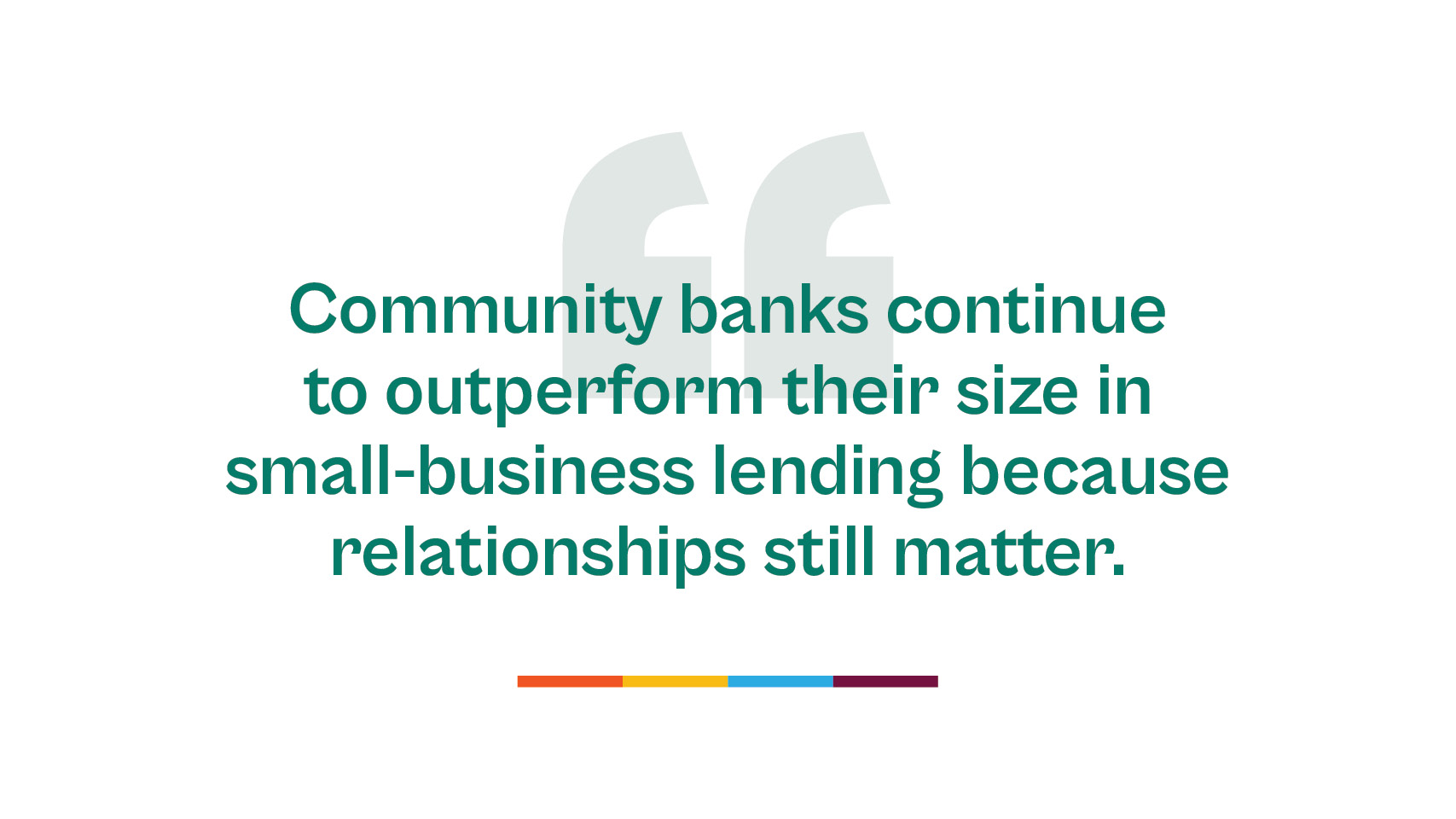
According to the FDIC and Federal Reserve, community banks play an outsized role in small-business lending, holding 42% of U.S. small-business loans while representing just 13% of banking industry assets, and 82% of small-business applicants at small banks were at least partially approved in 2022, compared with 68% at larger banks. The SBA’s summary of Federal Reserve survey data also found that 49% of community-bank small-business customers used community banks for small-business lending, underscoring their importance as a source of capital for local firms.
Beyond financing, the FDIC and the Federal Reserve research notes that community banks are especially valuable because they rely on local knowledge and relationship-based lending, which can provide small businesses with more flexible terms and ongoing support. In short, helping small businesses thrive is what local banks are best positioned to do.
The marketplace model builds on this understanding.
It allows banks to remain deeply involved in how businesses operate while adapting to changes in technology and customer expectations. It creates opportunities to strengthen customer relationships, support businesses as they grow, and contribute to the overall well-being of the community.
For many institutions, the shift is not about becoming something new. It is about evolving how they deliver value in a way that reflects the realities of today’s business environment.
See how community banks are using curated marketplaces to connect customers with the tools and services they need to operate more effectively and grow with confidence. Learn more here.


Browse more topics from this article
Heading 1
Heading 2
Heading 3
Heading 4
Heading 5
Heading 6
Lorem ipsum dolor sit amet, consectetur adipiscing elit, sed do eiusmod tempor incididunt ut labore et dolore magna aliqua. Ut enim ad minim veniam, quis nostrud exercitation ullamco laboris nisi ut aliquip ex ea commodo consequat. Duis aute irure dolor in reprehenderit in voluptate velit esse cillum dolore eu fugiat nulla pariatur.
Block quote
Ordered list
- Item 1
- Item 2
- Item 3
Unordered list
- Item A
- Item B
- Item C
Bold text
Emphasis
Superscript
Subscript
Heading 1
Heading 2
Heading 3
Heading 4
Heading 5
Heading 6
Lorem ipsum dolor sit amet, consectetur adipiscing elit, sed do eiusmod tempor incididunt ut labore et dolore magna aliqua. Ut enim ad minim veniam, quis nostrud exercitation ullamco laboris nisi ut aliquip ex ea commodo consequat. Duis aute irure dolor in reprehenderit in voluptate velit esse cillum dolore eu fugiat nulla pariatur.
Block quote
Ordered list
- Item 1
- Item 2
- Item 3
Unordered list
- Item A
- Item B
- Item C
Bold text
Emphasis
Superscript
Subscript
Heading 1
Heading 2
Heading 3
Heading 4
Heading 5
Heading 6
Lorem ipsum dolor sit amet, consectetur adipiscing elit, sed do eiusmod tempor incididunt ut labore et dolore magna aliqua. Ut enim ad minim veniam, quis nostrud exercitation ullamco laboris nisi ut aliquip ex ea commodo consequat. Duis aute irure dolor in reprehenderit in voluptate velit esse cillum dolore eu fugiat nulla pariatur.
Block quote
Ordered list
- Item 1
- Item 2
- Item 3
Unordered list
- Item A
- Item B
- Item C
Bold text
Emphasis
Superscript
Subscript
Heading 1
Heading 2
Heading 3
Heading 4
Heading 5
Heading 6
Lorem ipsum dolor sit amet, consectetur adipiscing elit, sed do eiusmod tempor incididunt ut labore et dolore magna aliqua. Ut enim ad minim veniam, quis nostrud exercitation ullamco laboris nisi ut aliquip ex ea commodo consequat. Duis aute irure dolor in reprehenderit in voluptate velit esse cillum dolore eu fugiat nulla pariatur.
Block quote
Ordered list
- Item 1
- Item 2
- Item 3
Unordered list
- Item A
- Item B
- Item C
Bold text
Emphasis
Superscript
Subscript
Heading 1
Heading 2
Heading 3
Heading 4
Heading 5
Heading 6
Lorem ipsum dolor sit amet, consectetur adipiscing elit, sed do eiusmod tempor incididunt ut labore et dolore magna aliqua. Ut enim ad minim veniam, quis nostrud exercitation ullamco laboris nisi ut aliquip ex ea commodo consequat. Duis aute irure dolor in reprehenderit in voluptate velit esse cillum dolore eu fugiat nulla pariatur.
Block quote
Ordered list
- Item 1
- Item 2
- Item 3
Unordered list
- Item A
- Item B
- Item C
Bold text
Emphasis
Superscript
Subscript




.png)


