The Benefits of AI for Platform Teams (Hint: It’s Not About Speed)
Most conversations about artificial intelligence still revolve around one idea: speed. Teams want faster analysis, faster workflows, and faster decisions as a result. While this need for speed feels exciting and progressive, focusing solely on that framing misses the point of leveraging AI.
Speed has never really been the constraint in the platform ecosystem. Even without advanced ai tools, teams have always moved quickly when needed. The real challenge shows up somewhere else after the decision is made, when outcomes don’t match expectations, and when the same mistakes regularly repeat across investment portfolios.
What we are seeing with our VC and PE clients is that the real value of AI for platform teams starts to emerge when the core focus shifts from acceleration to clarity. Let's break down what that means.
The Real Constraint Isn’t Actually Time But Memory.
Across many organizations, platform teams sit at the intersection of multiple companies, multiple decisions, and constantly changing market conditions.
Every quarter, dozens of vendor selections, hiring decisions, and strategic bets are made. Each one generates useful data around what worked, what didn’t, and where assumptions broke down. But that knowledge rarely compounds.
It gets lost in conversations, buried in reporting, or tied to individuals instead of systems.
Over time, this creates a real gap. Teams end up making decisions based on experience rather than structured insights. As the ecosystem grows and the supply chain expands, you end up with a much longer learning cycle and many underleveraged opportunities that are not easy to spot at the individual level.
Is Speed Really the Advantage?
There’s a growing narrative that using AI leads to faster decision-making. And there is some truth in that. However, in practice, faster decision-making is only valuable if the underlying inputs improve. Otherwise, you’re just accelerating inconsistency.
Platform teams don’t need to move faster through the same flawed process. They need to reduce repetition. They need to understand patterns across companies. They need to improve how organizational decisions evolve over time. That should be the shift we are reaching for in this AI-heavy era.
What AI Actually Changes
Contrary to popular beliefs, the benefit of AI solutions is not that they replace people but that they change what teams can see and expand what teams can accomplish within a given timeframe.
Instead of relying on fragmented inputs, AI systems can aggregate market data, internal performance signals, and customer feedback across companies, which creates a more consistent foundation for decision-making.
Over time, that leads to something more valuable than speed: pattern recognition.
Teams can start to detect patterns in vendor performance, hiring outcomes, or operational bottlenecks. They can understand how decisions behave across different environments and over a longer time horizon.
When we talk about predictive models and predictive analytics, their usefulness becomes evident as tools for surfacing insights grounded in real outcomes.
Inputs That Lead to Understanding
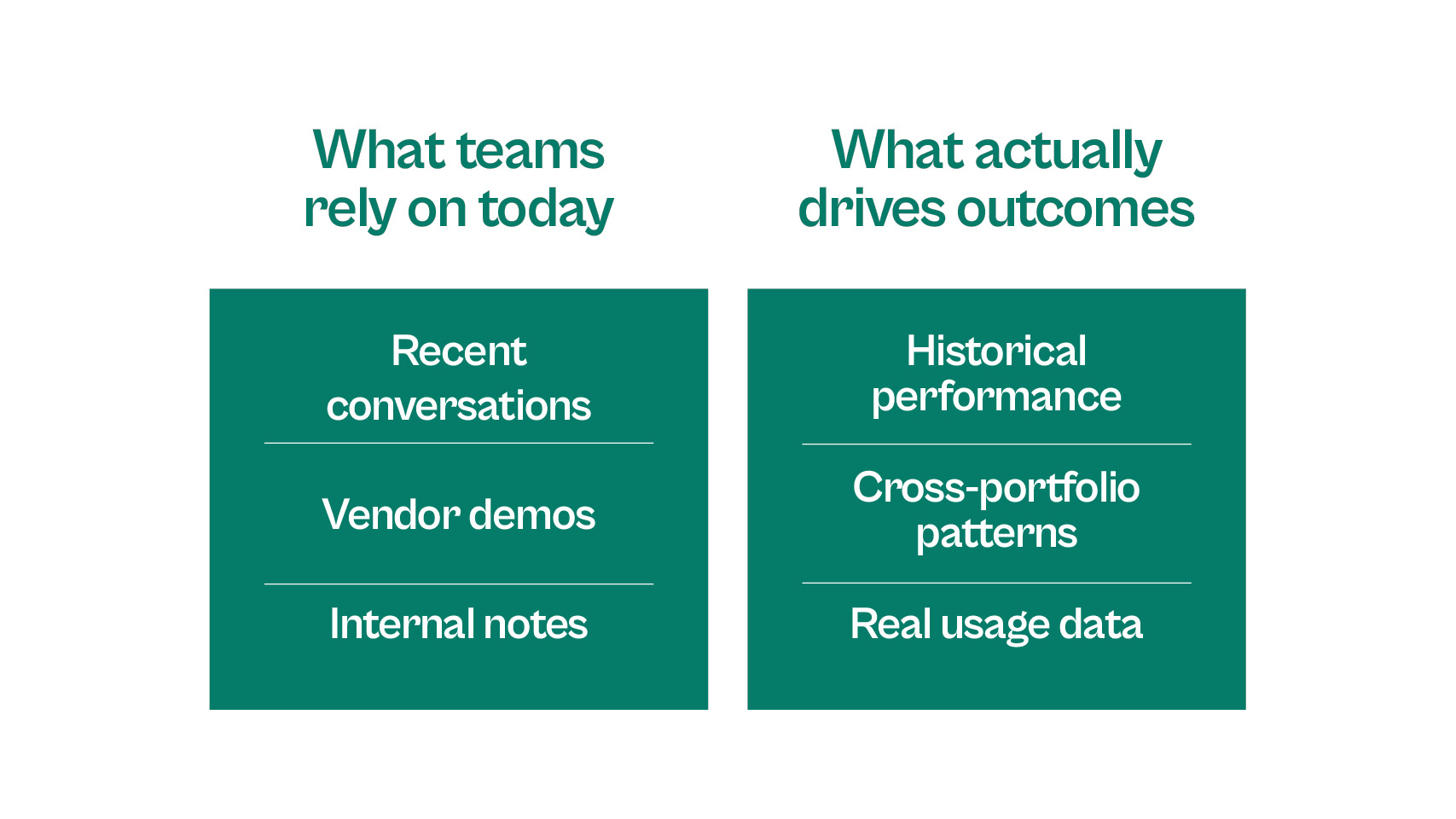
Most platform teams already have access to a wide range of existing tools. The challenge is that those tools don’t always connect. Important signals sit across systems:
- financial performance in one place
- operational metrics in another
- qualitative feedback somewhere else
Without proper integration, teams are left stitching together partial views.
When AI-powered systems are layered on top of these existing systems, they can bring that information together in a way that’s easier to interpret. Instead of isolated metrics, teams get actionable insights that reflect how different variables interact. This improves workflow optimization, but more importantly, it improves understanding.
What This Means for Platform Teams
For platform teams, the advantage is subtle but meaningful.
Instead of reacting to issues after they appear, teams can start to surface risks earlier. They can identify potential risks before they become operational problems. They can set clearer risk thresholds and apply them consistently across companies.
It also changes how teams support founders. Rather than offering advice based on memory or anecdote, they can provide context grounded in patterns. That builds confidence not just in the recommendation, but in the process behind it.
It also improves alignment internally. When insights are shared and consistent, it’s easier to maintain alignment across cross functional groups and across different teams within the platform.
The Role of Human Judgment
It’s important to be clear about what doesn’t change. Human judgment still matters and so does human oversight.
AI doesn’t remove responsibility from decision makers. It changes the quality of the inputs they work with. It highlights where assumptions don’t match reality. It helps teams evaluate trade-offs with more context.
In practice, this means platform teams spend less time on low-value work such as gathering information, reconciling data, running manual comparisons, and more time on interpretation and strategy. That’s where real leverage comes from.
What AI Doesn’t Solve
Not every problem is a data problem. AI won’t fix unclear goals. It won’t resolve internal misalignment. It won’t replace strong change management or good communication.
It also doesn’t eliminate the need for strong processes around compliance checks, regulatory requirements, and broader compliance considerations. In fact, those areas often require even more attention as systems become more complex. What AI can do is make those processes more consistent, more transparent, and easier to manage at scale.
Where This Is Going
As AI adoption increases, the baseline will shift. What feels like an advantage today, being able to connect data, generate insights, and improve productivity, will become table stakes sooner rather than later.
The real differentiation will come from how well teams use these capabilities to improve outcomes over time. That includes:
- building strong feedback loops
- continuously improving model accuracy
- applying granular control over how systems are used
- ensuring that model outputs remain aligned with real-world context
This is less about implementing a single AI model and more about creating an environment of continuous learning.
Building Trust
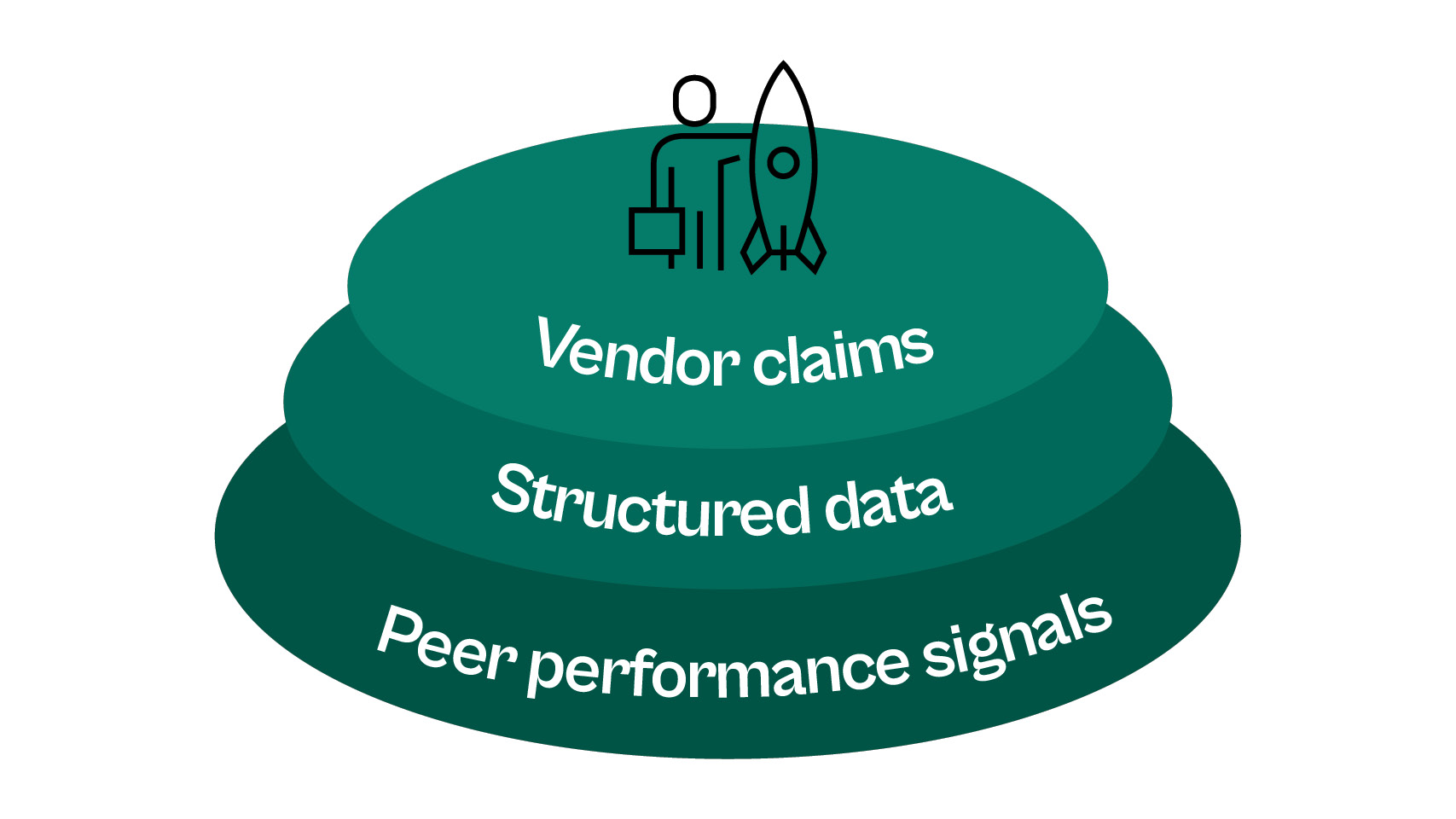
As platform teams rely more heavily on ai powered systems and aggregated data, another dynamic starts to emerge. Not all data carries the same weight.
In fact, as AI adoption increases, it becomes easier, not harder, for vendors to shape perception. Synthetic case studies, inflated benchmarks, and even fabricated signals can start to blend in with legitimate information. The surface layer of data becomes noisier, even as the underlying systems become more sophisticated.
This creates a new challenge. If every vendor can present strong-looking model outputs, how do teams know what to trust?
The best and most foolproof solution for platform teams is peer-to-peer knowledge sharing. For platform teams, the most reliable signals often come from within the network itself, and what other companies have actually experienced over time.
This kind of input is harder to manufacture because it’s grounded in lived experience:
- how a vendor performs after implementation
- how it integrates with real workflows
- how it responds when things don’t go as planned
When that information can be shared consistently across a portfolio, it becomes a powerful layer of validation. It allows teams to cross-check what the data suggests against what peers have seen. It adds context to predictive insights and helps identify where signals may not fully reflect reality.
Over time, this creates a more durable form of trust that isn't based on marketing or data inputs but rather on shared experience and repeated outcomes across companies facing similar constraints.
Unfortunately, few solutions do a good job at surfacing this peer-based layer of intelligence. Most tools help teams collect data. Very few help them capture and share what actually happens after a decision is made. The insight stays fragmented and locked in conversations, making it very difficult to apply systematically.
Closing that gap requires more than better analytics. It requires a way to structure and surface peer-based performance signals so they can be used alongside everything else.
That’s the direction Proven has been building toward.
Beyond vendor discovery, we've designed and curated a way to make real-world outcomes visible across a trusted network so that teams can evaluate decisions with both data and shared experience, not one or the other.
The Bigger Opportunity
For platform teams, the real opportunity isn’t just better tools or faster workflows.
It’s building a system where decisions actually improve over time.
That requires more than access to data or even better insights. It requires combining structured analysis with signals that reflect what happens in practice. Without that, teams risk optimizing around incomplete information, no matter how advanced the underlying systems become.
As AI systems continue to evolve, they will get better at aggregating information, identifying patterns, and generating recommendations. But their effectiveness will still depend on the quality of the inputs they rely on. We believe the real opportunity lies in also integrating peer-to-peer signals within your ecosystem.
When platform teams can layer real-world performance data, what actually happened after a decision, on top of broader analysis, they begin to close the gap between evaluation and outcome. Decisions become less about projection and more about evidence. Over time, this creates a different kind of advantage.
Instead of each company learning independently, knowledge starts to compound across the portfolio, patterns become visible earlier, outliers are easier to identify, and teams can intervene before small issues turn into systemic problems. This is what allows platform teams to operate with greater consistency, even as the complexity of their business environments continues to grow.
The Bottom Line
The benefits of AI for platform teams go beyond speed. It's about fundamentally improving how decisions evolve and how trust is built around those decisions.
As more organizations adopt AI, the volume of available data will continue to increase. But more data doesn’t automatically lead to better outcomes. In many cases, it creates more noise.
The teams that perform best will be the ones that can distinguish between signal and noise. And that will come down to having the right models and better inputs, combined with structured analysis and trusted, peer-based insight.
That’s what allows platform teams to move beyond isolated decisions and build a system that consistently produces stronger results. And it’s why the real advantage of AI is less about how fast you can decide and more about how reliable those decisions are and whether they hold up over time.
For teams looking to move in this direction, the next step is having access to the right signals, which is exactly what Proven is designed to provide.


Browse more topics from this article
Heading 1
Heading 2
Heading 3
Heading 4
Heading 5
Heading 6
Lorem ipsum dolor sit amet, consectetur adipiscing elit, sed do eiusmod tempor incididunt ut labore et dolore magna aliqua. Ut enim ad minim veniam, quis nostrud exercitation ullamco laboris nisi ut aliquip ex ea commodo consequat. Duis aute irure dolor in reprehenderit in voluptate velit esse cillum dolore eu fugiat nulla pariatur.
Block quote
Ordered list
- Item 1
- Item 2
- Item 3
Unordered list
- Item A
- Item B
- Item C
Bold text
Emphasis
Superscript
Subscript
Heading 1
Heading 2
Heading 3
Heading 4
Heading 5
Heading 6
Lorem ipsum dolor sit amet, consectetur adipiscing elit, sed do eiusmod tempor incididunt ut labore et dolore magna aliqua. Ut enim ad minim veniam, quis nostrud exercitation ullamco laboris nisi ut aliquip ex ea commodo consequat. Duis aute irure dolor in reprehenderit in voluptate velit esse cillum dolore eu fugiat nulla pariatur.
Block quote
Ordered list
- Item 1
- Item 2
- Item 3
Unordered list
- Item A
- Item B
- Item C
Bold text
Emphasis
Superscript
Subscript
Heading 1
Heading 2
Heading 3
Heading 4
Heading 5
Heading 6
Lorem ipsum dolor sit amet, consectetur adipiscing elit, sed do eiusmod tempor incididunt ut labore et dolore magna aliqua. Ut enim ad minim veniam, quis nostrud exercitation ullamco laboris nisi ut aliquip ex ea commodo consequat. Duis aute irure dolor in reprehenderit in voluptate velit esse cillum dolore eu fugiat nulla pariatur.
Block quote
Ordered list
- Item 1
- Item 2
- Item 3
Unordered list
- Item A
- Item B
- Item C
Bold text
Emphasis
Superscript
Subscript
Heading 1
Heading 2
Heading 3
Heading 4
Heading 5
Heading 6
Lorem ipsum dolor sit amet, consectetur adipiscing elit, sed do eiusmod tempor incididunt ut labore et dolore magna aliqua. Ut enim ad minim veniam, quis nostrud exercitation ullamco laboris nisi ut aliquip ex ea commodo consequat. Duis aute irure dolor in reprehenderit in voluptate velit esse cillum dolore eu fugiat nulla pariatur.
Block quote
Ordered list
- Item 1
- Item 2
- Item 3
Unordered list
- Item A
- Item B
- Item C
Bold text
Emphasis
Superscript
Subscript
Heading 1
Heading 2
Heading 3
Heading 4
Heading 5
Heading 6
Lorem ipsum dolor sit amet, consectetur adipiscing elit, sed do eiusmod tempor incididunt ut labore et dolore magna aliqua. Ut enim ad minim veniam, quis nostrud exercitation ullamco laboris nisi ut aliquip ex ea commodo consequat. Duis aute irure dolor in reprehenderit in voluptate velit esse cillum dolore eu fugiat nulla pariatur.
Block quote
Ordered list
- Item 1
- Item 2
- Item 3
Unordered list
- Item A
- Item B
- Item C
Bold text
Emphasis
Superscript
Subscript



.png)