What VC Platform Teams Wish Founders Knew About Vendors

Vendor decisions in VC-backed companies are often made under time pressure, with limited peer context and incomplete visibility into long-term tradeoffs. While teams move fast for good reason, this leads to duplicated research, avoidable mistakes, and operational risk that compounds as companies scale.
This article explains why vendor selection is an early strategic decision (not a procurement task) and highlights the most common mistakes founders make when evaluating vendors. It outlines what platform teams wish portcos knew upfront, including how peer insight, stage fit, and real-world implementation experience matter more than demos or marketing claims.
You’ll also find a practical framework for evaluating vendors, guidance on avoiding hidden costs and security risks, and an explanation of how shared portfolio insight helps platform teams and founders make faster, smarter vendor decisions without adding process.

Every VC platform operator has lived this moment: a portfolio company announces they’ve chosen a new tool or service, and you can already see the second-order effects coming. Not because the vendor is bad, but because the decision was made without context. There was no insight into how similar portfolio companies evaluated that vendor, what tradeoffs surfaced later, or what hidden costs emerged after onboarding.
This is one of the most common execution drags in venture-backed portfolios. Early-stage teams move fast by necessity. Vendor decisions are made under time pressure, often by a small group of key stakeholders, using incomplete information and a fragmented vendor selection process.
It may not lead to catastrophic results, but it does create unnecessary inefficiencies, duplicated vendor research, and sometimes even operational risk that compounds as the company scales.
A lot of people assume vendor selection is just procurement. It's not. It’s an early strategic decision that shapes a company’s tech stack, workflows, and long-term operating ceiling.
Platform teams all share the same wish:
If founders understood a few realities upfront, the full vendor selection process would be faster, clearer, and far less costly for everyone involved.
This article outlines six insights platform teams wish every founder knew before choosing vendors. At the end, you will also get a simple playbook for executing smarter vendor selection.
💡 If you’re still early in the process, this resource breaks down how to think about tech stack decisions before they become hard to unwind: How to Choose the Right Tech Stack for Your Startup
1. Vendor Selection Is a Bigger Strategic Decision Than Founders Think
In early-stage companies, choosing vendors is often treated as a lightweight task comprising a few demos, some RFP responses, maybe a reference call, and then moving on. But in venture-backed businesses, vendor choices directly influence business operations, financial reporting, operational efficiency, and even revenue growth.
That’s why vendor selection for portfolio companies should not be approached purely as an administrative task but instead as a strategic inflection point. Early vendor choices shape how data flows, how teams collaborate, how customers are supported, and how easily systems scale or unwind later.
A misaligned vendor choice introduces friction, technical debt, and hidden costs.
The right vendor, selected with context, can accelerate execution and create a real competitive advantage for the founding team.
2. There Are Common Vendor Mistakes VC Portcos Make Which Can Be Avoided
In venture-backed companies, speed is often a competitive advantage, but it also shapes how vendors are chosen. The current vendor selection process in many VC portcos is optimized for momentum, not learning, which is why the same issues show up repeatedly across portfolios.
One of the most common mistakes is prioritizing brand recognition over proven vendor capabilities. Well-known vendors often look like the safe choice, but without validating fit against actual business needs, teams risk selecting tools that are too complex, too rigid, or poorly suited to their stage.
Another frequent issue is jumping straight into demos before defining success. When teams don’t align internally on what problem they’re solving, the selection process becomes reactive. This makes it harder to evaluate how a vendor will perform beyond its first few customers or adapt as the company grows.
Commercial terms are another blind spot. Early-stage teams often negotiate payment terms and contract terms without leverage or long-term visibility, assuming popular tools guarantee consistent quality. In reality, overlooked details around pricing escalators, usage thresholds, or renewal clauses can introduce unexpected constraints later.
Operational considerations are also easy to underestimate. Ongoing maintenance, integrations, and data portability are rarely front-of-mind during early evaluations, yet they significantly impact flexibility and cost over time. Similarly, teams may gloss over potential risks tied to a vendor’s security posture or scalability until those risks become urgent.
Finally, onboarding is often treated as a one-time milestone rather than a long-term commitment. When implementation is rushed, even a strong vendor can struggle to deliver value.
These are not founder failures. They are predictable outcomes of fast-moving environments with limited peer visibility. With clearer context and shared learning across the portfolio, many of these vendor mistakes can be avoided entirely.

3. Peer Insight Matters More Than Vendor Promises
If platform teams could standardize one thing across the portfolio, it wouldn’t be tools or vendors; it would be perspective.
In venture-backed environments, most vendor decisions start in the same place: a problem emerges, a few names surface through networks or industry events, and teams move quickly into demos.
What gets far less attention is the most predictive input of all: how similar companies actually experienced that vendor after the contract was signed.
That’s because vendor promises are designed to travel well. They sound equally compelling to a 10-person startup and a 100-person company. Peer says otherwise.
The best signal of success isn’t marketing copy, feature lists, or polished case studies. It’s whether companies at a similar stage, with similar business needs and constraints, were able to implement the product without introducing friction into their business operations. That kind of insight doesn’t show up in sales decks because it can only come from other operators who’ve lived with the decision.
Vendor pitches ≠ vendor reality.
This gap between pitch and reality is where many avoidable issues begin. Sales cycles optimize for momentum; implementation exposes the real work. Support quality, onboarding ownership, integration effort, and responsiveness under pressure only become visible after go-live. Without peer context, teams systematically underestimate these factors.
That's why vendor due diligence matters even in early-stage companies, not in the form of heavyweight procurement, but through informed conversations. Platform teams consistently encourage founders to ask questions like:
- How long did it take before the tool delivered real value?
- Who owned the vendor relationship once implementation started?
- What broke first when usage increased?
- How did the vendor respond when priorities shifted?
Answers to these questions reveal far more than feature comparisons. They surface potential risks, clarify true vendor capabilities, and help teams understand whether a vendor can support growth without slowing execution.
Most importantly, peer insight changes how vendors are evaluated. Instead of asking “Is this a good vendor?” teams start asking “Was this the right vendor for companies like us?” That shift alone helps founders avoid costly mistakes, shorten evaluation cycles, and build long-term vendor partnerships that actually support scale.
For platform teams, making this insight visible isn’t about control; it’s about giving founders a clearer starting point. When teams can learn from each other’s experiences, vendor decisions stop being isolated bets and start becoming shared knowledge that compounds across the portfolio.
.jpg)
4. Why Peer Insight Beats Demos and Case Studies
Vendor demos and case studies are designed to show what could work in ideal conditions. Peer insight shows what actually happens once the contract is signed and the tool becomes part of day-to-day execution.
Demos are curated. Case studies are selective. Peer feedback is lived reality.
For VC-backed companies moving quickly, this distinction matters. Early vendor decisions rarely fail because the product doesn’t work at all. More often than not, they fail because implementation friction, support gaps, or misaligned incentives surface after launch. These issues are almost invisible during a polished sales process.
A strong vendor evaluation process that incorporates peer insight consistently surfaces things traditional diligence misses, including:
- Where onboarding stalled or required more internal effort than expected
- How responsive support was once the deal moved from sales to service
- Sources of recurring operational friction that slowed teams down
- Downstream effects on customer satisfaction, especially when vendors touched customer-facing workflows
- Unexpected indirect procurement costs tied to add-ons, integrations, or usage thresholds
This type of insight changes the quality of decision-making. It allows teams to assess vendors not just on features, but on how they behave under real operating conditions, when priorities shift, headcount grows, or systems need to integrate quickly.
For platform teams, peer insight becomes a practical risk signal. It strengthens risk management by highlighting where similar companies encountered trouble and helps founders avoid costly mistakes before they become embedded in the operating model. Instead of learning the hard way, teams can anticipate friction and factor it into their selection process.
In fast-moving environments, that advantage compounds. Peer insight doesn’t slow decisions down; instead, it prevents reversals, churn, and rework later, when the cost of change is far higher.
5. A Practical Vendor Evaluation Framework for VC-Backed Teams
After understanding why peer insight matters, the next question founders ask is simple: Where do we actually start?
VC-backed teams don’t need heavyweight procurement processes or enterprise tooling. What they need is a structured evaluation that keeps pace with growth, reflects real operating constraints, and reduces the chance of costly reversals later.
A practical vendor evaluation framework starts with clarity, not volume.
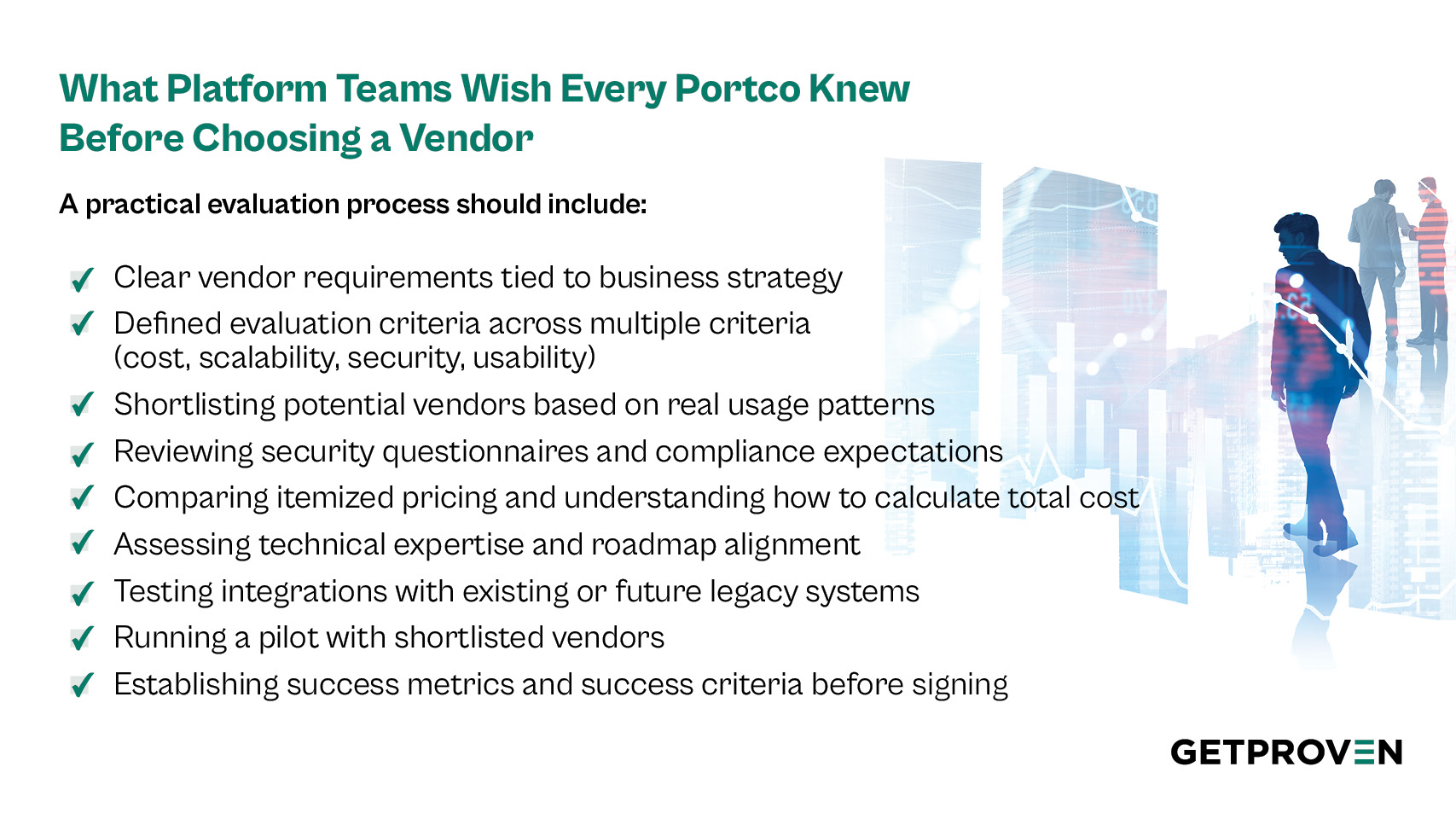
First, teams should define vendor requirements in the context of the broader business strategy. This means being explicit about what problem the vendor is solving today and how that solution needs to evolve as the company scales. Without this step, every demo sounds compelling, and the evaluation quickly drifts.
Next comes a clear set of evaluation criteria built around multiple criteria that actually matter in practice: cost over time, scalability, security expectations, usability for day-to-day teams, and fit with existing workflows. These criteria should be agreed on before conversations begin, not retrofitted afterward.
From there, teams can narrow the field by shortlisting potential vendors based on real usage patterns and ideally informed by peer insight from similar companies. This keeps the focus on vendors that have already proven viable in comparable environments, rather than expanding the list unnecessarily.
As the shortlist takes shape, teams should conduct focused diligence:
- Reviewing security questionnaires and compliance expectations early
- Comparing itemized pricing and learning how to calculate total cost, not just year-one fees
- Assessing technical expertise and roadmap alignment
- Testing integrations with current systems and likely legacy systems the company may inherit
Before committing, running a limited pilot with shortlisted vendors is often the fastest way to surface real friction. Even a small trial can reveal onboarding gaps, performance issues, or support limitations that never show up in demos.
Finally, teams should define success metrics and success criteria upfront. What does “working” actually mean three, six, or twelve months after launch? This step anchors the relationship in outcomes rather than promises and sets the foundation for accountability.
Taken together, this approach to evaluating vendors doesn’t slow teams down. It creates enough structure to avoid reactive decisions while still supporting speed. Most importantly, it helps founders build long-term vendor partnerships that scale with the business instead of becoming liabilities as the company grows.
6. Tech Stack Decisions Define Operational Trajectory
Early tech stack decisions tend to feel reversible. Tools are chosen to solve immediate problems, with the assumption that they can be swapped out later if needed. In practice, those decisions become far more durable than expected.
Once embedded, the tech stack shapes how a company actually operates day to day. It influences how teams collaborate, how data moves through the organization, how reliably numbers can be trusted, and how quickly decisions can be made.
As companies grow, these tools begin to touch more critical workflows (from internal reporting to customer-facing processes) and, in some cases, supply chain coordination.
When early vendor choices aren’t well aligned, the consequences show up gradually. Teams compensate with manual workarounds. Data becomes harder to reconcile. Integrations multiply. Over time, these issues increase operational risk, limit flexibility, and create dependencies that are expensive and disruptive to unwind, often at the exact moment the business needs to move faster.
By contrast, a well-aligned stack creates leverage. When tools fit the company’s stage and direction, teams spend less time maintaining systems and more time executing. Operational efficiency improves, performance tracking becomes more reliable, and leadership gains clearer visibility into what’s actually happening inside the business. That clarity makes it easier to scale processes, onboard new hires, and support growth without constant rework.
This is one of the key reasons platform teams insist on being intentional with the tech stack as early in the game as possible. They’re not just selecting tools; they’re helping define the operating trajectory of the company. The right choices don’t eliminate change, but they make growth easier, decisions faster, and course corrections far less painful as the business scales.
[Image 06: Graphic illustration of a lens looking out into the horizon]
A Practical Decision Lens for Smarter Vendor Selection
At this stage, founders don’t need another checklist or prescriptive process. What they need is a way to slow down just enough to pressure-test a vendor decision before it becomes embedded in the business.
Platform teams should consistently encourage founders to use a simple decision lens before committing. One that surfaces risk, context, and second-order effects without adding friction.
That lens usually starts with peer context. Before evaluating features or pricing, founders should look at how similar companies within their portfolio approached the same problem: what vendors they considered, what tradeoffs emerged after implementation, and what they would do differently now. This step alone eliminates a surprising amount of noise.
Next is clarity around vendor selection criteria. Rather than evaluating vendors in the abstract, teams should confirm what success actually looks like for their stage and business operations. This includes who will own the vendor relationship internally, how the tool fits into existing workflows, and what happens when priorities shift.
Wherever possible, have a targeted vendor due diligence, focused less on exhaustive documentation and more on practical risk. That means understanding failure modes, reviewing contract terms, and testing basic contingency plans in case the vendor underperforms or needs to be replaced.
Finally, founders should confirm how the vendor will integrate into the broader operating environment. This includes alignment with internal systems, external suppliers, and any dependencies that could complicate future changes.
This approach doesn’t standardize tools or slow teams down. It standardizes learning. By applying the same lens across decisions, founders make more informed choices, platform teams gain consistency in how decisions are evaluated, and vendor selection becomes a source of confidence rather than rework.
Founder Takeaway
Before committing to a vendor, slow down just enough to pressure-test the decision. Look at how similar companies approached the same problem, clarify what success actually looks like for your stage, and understand who will own the vendor relationship over time.
Focus your diligence on where things tend to break ( implementation, support, contract terms, and exit paths), not just features and pricing.
A few intentional questions upfront can prevent months of rework later and keep vendor decisions aligned with how your company actually needs to operate as it scales.
How Proven Supports Smarter Vendor Decisions
Proven isn’t a procurement engine; it’s a centralized system for shared learning across the portfolio. It helps VC platform teams and founders see how vendor based decisions play out across companies, compare potential vendors, and track real-world outcomes from ongoing vendor management. By leveraging technology to surface this context, teams can improve choosing vendors without adding process or slowing down day-to-day execution, while preserving founder autonomy.
Conclusion:
Strong vendor selection is rarely about getting everything right the first time. For platform teams, it’s about reducing avoidable friction and helping companies make informed choices as they grow. Much of the work happens behind the scenes. They're comparing past outcomes, learning where decisions broke down, and identifying what tends to support healthy company’s operations over time.
When platform teams share that context, the goal isn’t to slow founders down or add process. It’s to make it easier to choose from qualified vendors, avoid repeat mistakes, and build the best vendor relationships possible given the stage and constraints of the business. That support is meant to be additive, not restrictive.
It's about creating clarity without creating burden. When founders understand that intent, shared insight becomes a resource rather than a requirement, and vendor decisions feel less like checkpoints and more like informed steps forward.
Pro Tip: treat vendor selection as a conversation, not a gate.
Start by surfacing what’s already been learned across the portfolio, what worked, what didn’t, and why. Tools like Proven help make that knowledge easier to access, so platform teams can support founders without getting in the way.