
Choosing the Right Vendor Management Software: A Comprehensive Guide

Vendor management has become a growing challenge for modern platform teams. As portfolio companies expand, they rely on multiple vendors across technology, services, and talent, often spanning procurement teams, finance, operations, and legal. In response, many platform leaders turn to vendor management software, assuming that a state-of-the-art vendor management system will bring order to the chaos.
But in practice, most traditional approaches often fall short.
While robust end-to-end software solutions are important and do increase operational efficiency across the fund, when it comes to portcos, what platform teams need is to operate through influence.
Building an ecosystem and a thriving founder community is less about control and more about collaboration, transparency, and easy communication.
At this point, we often see a mismatch between the significant investments made for a new complex tool and the intended outcomes. That's why we want to share a missing layer that could finally close the gap between what platform teams want to accomplish and what actually supports their portcos.
Why Traditional Vendor Management Software Is Built for Control, Not Platforms
Most vendor management software is designed around a simple assumption: one team owns vendor decisions end to end. In this model, a vendor management system operates by enforcing standardized processes, automating workflows, establishing approval chains, and formalizing performance monitoring.
That approach can work in tightly controlled environments. But platform teams, especially those supporting global enterprises, distributed business units, or portfolio-style organizations, rarely own execution. They support it.
As a result, vendor management practices that rely on strict enforcement often struggle to gain adoption. Procurement teams may manage supplier management and negotiating contracts, but day-to-day vendor relationships live elsewhere. When tools don’t reflect this reality, vendor management plays break down before they ever deliver value.
The Real Challenge? Fragmented Vendor Data and Visibility
For most firms, the biggest challenge isn’t managing vendors, it’s understanding them.
Vendor data is scattered across spreadsheets, inboxes, shared drives, and disconnected management software. Vendor information changes constantly: contacts update, pricing shifts, contracts renew, and new vendors enter the picture.
Without a system that centralizes vendor data, platform leaders spend time answering basic questions instead of creating strategic advantage for their founders.
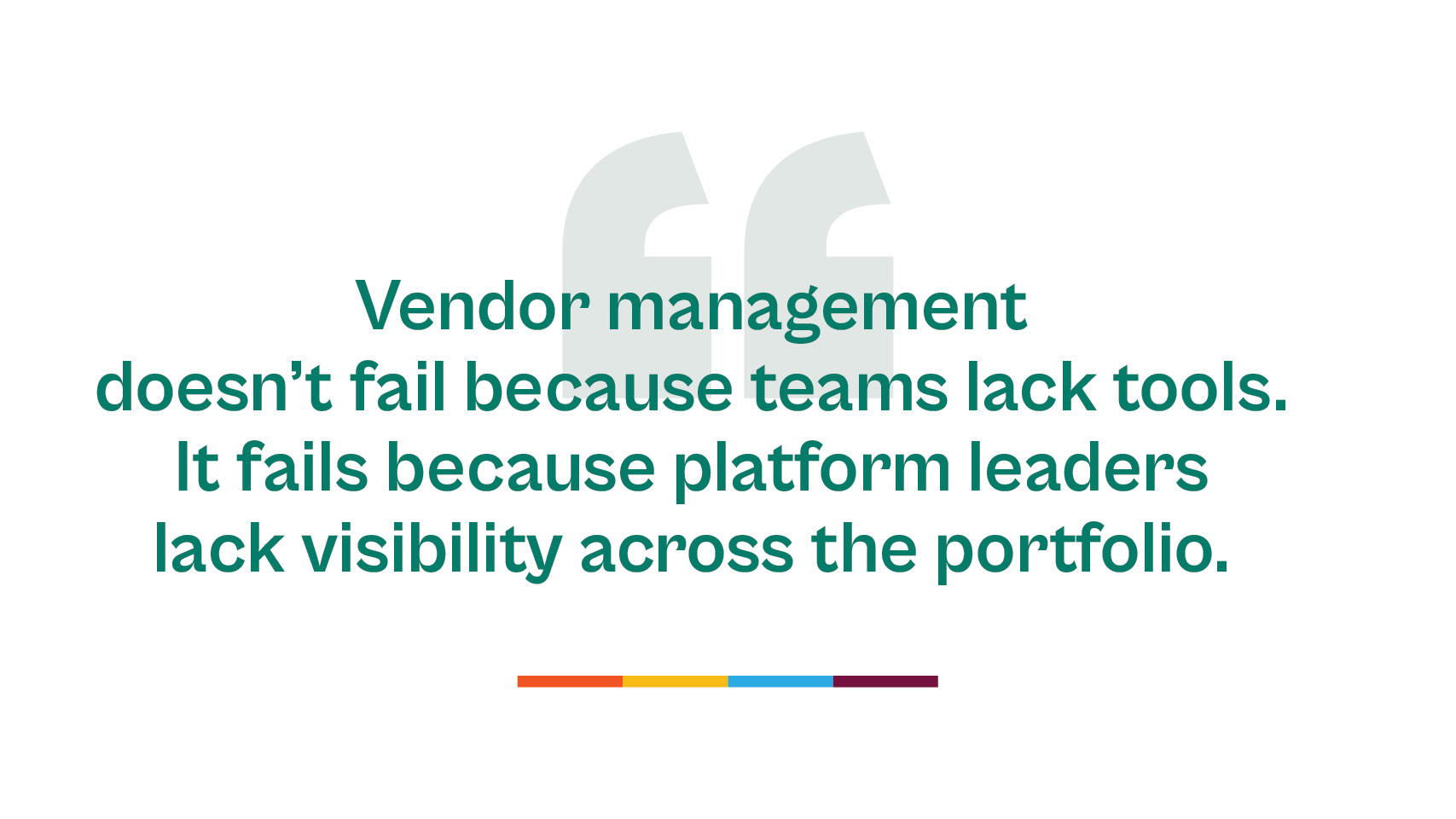
This fragmentation makes effective vendor management nearly impossible. Without consistent vendor information, management teams struggle to assess vendor risk, track supplier performance, or align vendor portfolios with business needs.
When the Vendor Management Process Becomes Too Heavy, Adoption Fails
In a VC platform ecosystem, vendor management doesn’t live in a single location. It lives across dozens of portfolio companies, each at a different stage, with different tools, budgets, and internal priorities.
Since platform teams don't run vendor process day to day, when visibility is limited, the instinct is often to add structure: standardized vendor scorecards, formal vendor onboarding requirements, layered approvals, and detailed vendor risk management frameworks.
On paper, this looks like progress, and it works up to a point. More often than not, however, it creates friction for portfolio companies that are focused on speed, hiring, and growth.
Heavy vendor management processes place too much burden on founding teams. They require time, training, and ongoing upkeep that founders and operators don’t have. As a result, adoption drops. Portfolio companies keep choosing vendors the way they always have, and platform teams end up back in spreadsheets, Slack threads, and one-off requests.
At that point, even the best-designed software loses its value. When a system feels like overhead rather than support, it doesn’t create operational efficiency or consistent oversight because it simply gets bypassed.
Performance Monitoring Without Context Doesn’t Improve Outcomes
For platform teams, vendor performance isn’t about formal scorecards or quarterly reviews. It shows up in more practical ways:
> which tools founders keep renewing,
> which vendors get recommended across the portfolio,
> and which services disappear after a failed rollout.
Traditional vendor management software often treats performance monitoring as a compliance exercise, tracking key performance indicators that look clean in a dashboard but say little about real value.
In a VC portfolio, that approach rarely works. Early-stage teams don’t have time to maintain vendor scorecards, and platform leaders don’t have the authority to enforce them.
What actually matters is the portfolio-level signal. Platform teams need to see which vendors are gaining traction, where spend is concentrating, and how vendor choices differ by company size or stage. They need insight into supplier performance that reflects lived experience, not just reported metrics.
Without that context, performance data becomes noise. With it, platform teams can make better recommendations, spot emerging strategic vendors, and support portfolio companies with guidance that’s grounded in reality rather than theory.
What about Vendor Risk Management?
Vendor risk management looks very different for early-stage startups than it does in large enterprises. Risk doesn’t come from managing massive supply chains or enforcing rigid compliance programs; it comes from limited visibility across dozens of fast-moving portfolio companies.
Platform teams are often expected to have the answers to questions like: Which vendors are mission-critical right now? Where are multiple companies relying on the same provider? Which tools are being adopted quickly, and which relationships are likely to create risk? Traditional third-party risk management tools aren’t built to answer those questions.
When visibility is low, the response is often to add layers: more compliance checks, more documentation, more formal risk assessments. But in a portfolio environment, this usually creates friction without reducing risk.
In practice, vendor risk shows up through blind spots such as outdated vendor information, unknown dependencies, unclear financial stability, and limited awareness of which vendors are truly critical across the portfolio.
Risk mitigation starts by making those blind spots visible. When platform teams have clarity on vendor usage and concentration, they can manage risk, reduce exposure, and support smarter decisions without slowing down portfolio companies.
Why Platform Teams Need a Layer, Not Another System
If vendor management continues to feel like an unnecessary headache for platform leaders, the solution isn’t to add more tools. It’s about layering on a system that reflects how decisions are actually made across a portfolio.
After years of supporting VC-backed startups and their platform heads, one pattern shows up consistently: vendor management works best when it’s simple, peer-informed, and focused on what founders actually need. Not rigid workflows or top-down enforcement, but shared visibility.
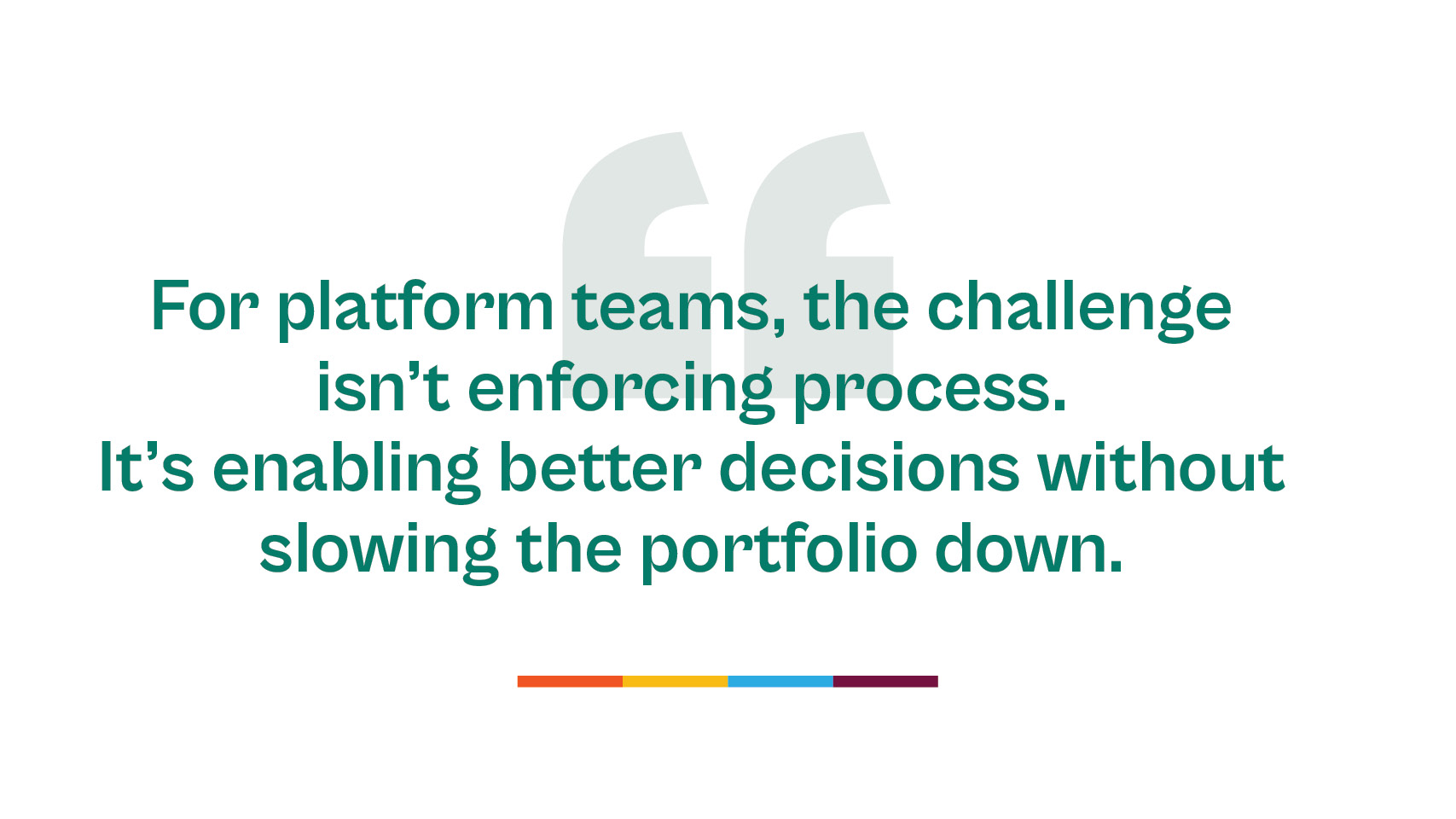
Platform teams create the most value when they can surface trusted vendors, show what peers are using, and help companies make faster, more confident decisions without slowing them down.
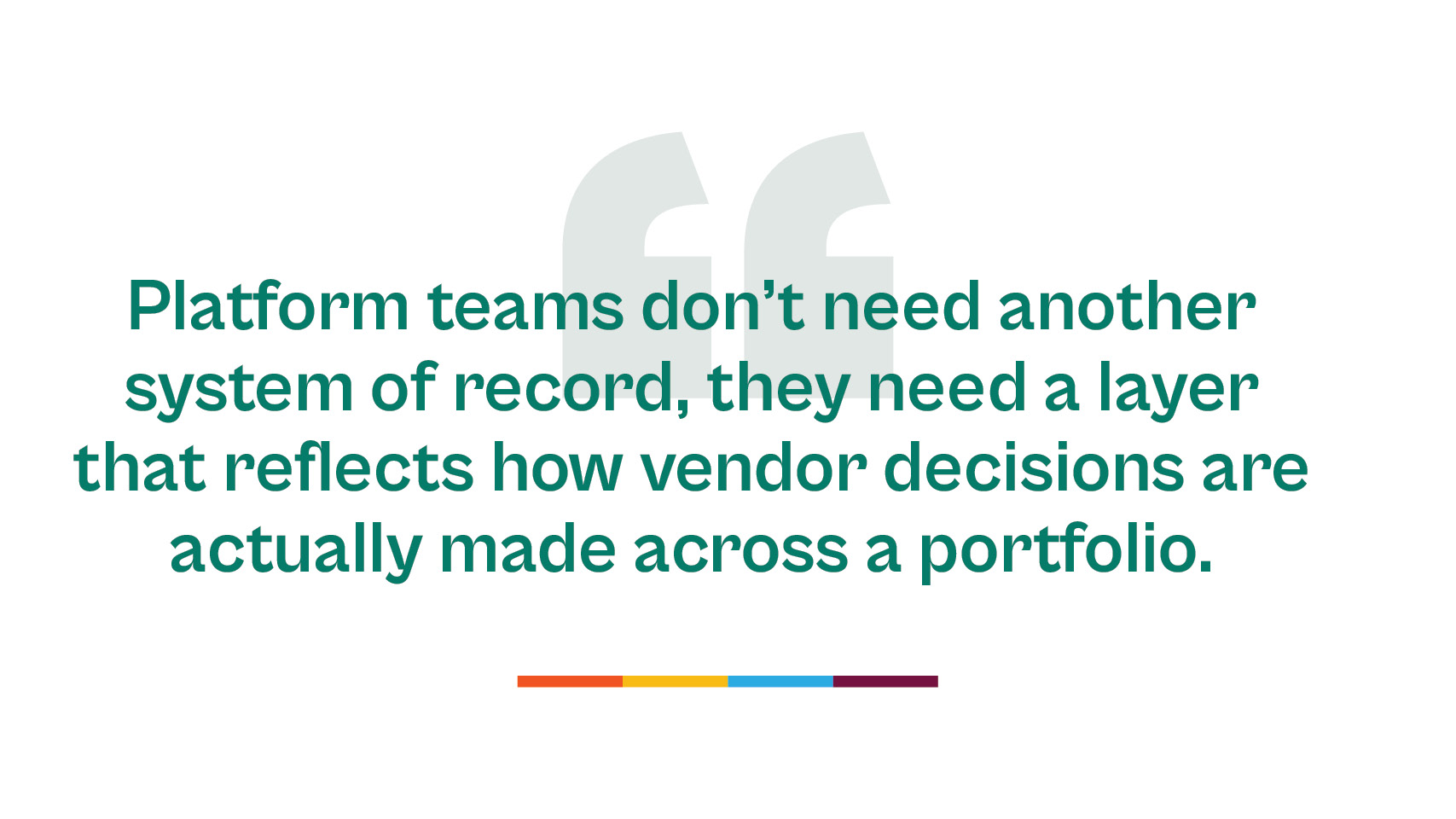
Instead of introducing another system of record, a more high-impact move is to add a vendor management layer that sits above existing tools and focuses on what platform teams actually need: shared visibility.
It centralizes vendor data, organizes vendor relationships across companies, and creates consistent oversight without asking founders to change how they work.
This shift changes the core question platform leaders ask. Instead of “How should this vendor management system work?” the question becomes: “What information do we need to help our portfolio make better vendor decisions?”
The result is a model that respects portfolio autonomy while still giving platform teams the clarity they need to create real value.
What Actually Works: Principles Platform Teams Are Adopting
Across industries, platform leaders are converging on a more practical model of vendor relationship management, one that complements existing systems rather than competing with them.
Effective approaches focus on:
- Centralizing vendor information so teams aren’t guessing
- Simplifying vendor onboarding for new vendors and strategic sourcing initiatives
- Supporting supplier relationships through shared insight, not mandates
- Enabling data analysis that reveals strategic insights across vendors
- Improving and automating relationship management without disrupting efficient processes
This model recognizes that vendor management best practices are about alignment, not enforcement.
The Strategic Value of Better Vendor Management
When vendor management plays are designed around clarity, organizations gain real leverage. Platform teams can:
- Support procurement teams without duplicating effort
- Control costs and uncover cost savings
- Improve service delivery across business units
- Support compliance checks and data security standards
- Reduce vendor risk and address potential risks earlier
Most importantly, vendor management becomes a strategic advantage rather than an administrative burden.
Conclusion:
For platform leaders, vendor management has never really been about tools. It’s been about making sense of a growing web of vendors, decisions, and trade-offs across a portfolio that’s moving fast.
When that context is missing, vendor management becomes reactive, fragmented, and harder to justify, no matter how sophisticated the software looks on paper.
What we’re seeing now is a shift in how platform teams approach the problem. Instead of trying to centralize control or roll out heavyweight systems, they’re prioritizing shared visibility. They want to understand which vendors are being used, where real value is coming from, and how portfolio companies are making decisions without adding friction or slowing founders down.
A lightweight, peer-focused vendor management layer fits the bill so well, not as a replacement for enterprise tools or another robust system to maintain, but as a streamlined solution that can organize vendor knowledge and facilitate portco vendor insights in ways traditional tools can't.
If vendor management still feels harder than it should and the value of platform support is difficult to quantify, it may be time to rethink the approach. Not by adding more software, but by adding the right layer: one that reflects how platform teams and founders actually work on the ground. Curious to see this in action? See how we work with VC platform teams here.


Browse more topics from this article
Heading 1
Heading 2
Heading 3
Heading 4
Heading 5
Heading 6
Lorem ipsum dolor sit amet, consectetur adipiscing elit, sed do eiusmod tempor incididunt ut labore et dolore magna aliqua. Ut enim ad minim veniam, quis nostrud exercitation ullamco laboris nisi ut aliquip ex ea commodo consequat. Duis aute irure dolor in reprehenderit in voluptate velit esse cillum dolore eu fugiat nulla pariatur.
Block quote
Ordered list
- Item 1
- Item 2
- Item 3
Unordered list
- Item A
- Item B
- Item C
Bold text
Emphasis
Superscript
Subscript
Heading 1
Heading 2
Heading 3
Heading 4
Heading 5
Heading 6
Lorem ipsum dolor sit amet, consectetur adipiscing elit, sed do eiusmod tempor incididunt ut labore et dolore magna aliqua. Ut enim ad minim veniam, quis nostrud exercitation ullamco laboris nisi ut aliquip ex ea commodo consequat. Duis aute irure dolor in reprehenderit in voluptate velit esse cillum dolore eu fugiat nulla pariatur.
Block quote
Ordered list
- Item 1
- Item 2
- Item 3
Unordered list
- Item A
- Item B
- Item C
Bold text
Emphasis
Superscript
Subscript
Heading 1
Heading 2
Heading 3
Heading 4
Heading 5
Heading 6
Lorem ipsum dolor sit amet, consectetur adipiscing elit, sed do eiusmod tempor incididunt ut labore et dolore magna aliqua. Ut enim ad minim veniam, quis nostrud exercitation ullamco laboris nisi ut aliquip ex ea commodo consequat. Duis aute irure dolor in reprehenderit in voluptate velit esse cillum dolore eu fugiat nulla pariatur.
Block quote
Ordered list
- Item 1
- Item 2
- Item 3
Unordered list
- Item A
- Item B
- Item C
Bold text
Emphasis
Superscript
Subscript
Heading 1
Heading 2
Heading 3
Heading 4
Heading 5
Heading 6
Lorem ipsum dolor sit amet, consectetur adipiscing elit, sed do eiusmod tempor incididunt ut labore et dolore magna aliqua. Ut enim ad minim veniam, quis nostrud exercitation ullamco laboris nisi ut aliquip ex ea commodo consequat. Duis aute irure dolor in reprehenderit in voluptate velit esse cillum dolore eu fugiat nulla pariatur.
Block quote
Ordered list
- Item 1
- Item 2
- Item 3
Unordered list
- Item A
- Item B
- Item C
Bold text
Emphasis
Superscript
Subscript
Heading 1
Heading 2
Heading 3
Heading 4
Heading 5
Heading 6
Lorem ipsum dolor sit amet, consectetur adipiscing elit, sed do eiusmod tempor incididunt ut labore et dolore magna aliqua. Ut enim ad minim veniam, quis nostrud exercitation ullamco laboris nisi ut aliquip ex ea commodo consequat. Duis aute irure dolor in reprehenderit in voluptate velit esse cillum dolore eu fugiat nulla pariatur.
Block quote
Ordered list
- Item 1
- Item 2
- Item 3
Unordered list
- Item A
- Item B
- Item C
Bold text
Emphasis
Superscript
Subscript




.png)


