Why 60% of Tier 1 VCs Have Institutionalized Vendor Infrastructure and What That Signals in 2026

Top-tier venture capital firms are experiencing a subtle but significant shift in 2026.
Half a decade ago, vendor management for VC firms was very informal. Platform teams were still a novel idea, and those who hired a platform manager role did so mainly as a new way to manage relationships between portcos and vendors. But this relationship-building and management pretty much happened via emails, shared docs, and Slack threads.
Deals were negotiated opportunistically and sporadically. It worked well until portfolios grew, expectations increased, and reporting requirements tightened.
Fast forward to now, and many Tier 1 venture capital firms treat vendor management as institutional infrastructure. Yes, it's still a small fraction of admin work and is mainly support-oriented, but it is now also seen as a structural layer. And that shift signals something bigger about where venture capital is heading.
For a VC firm, this isn’t about tools, it’s about ecosystem and institutionalization
When leading venture capitalists centralize vendor management, they aren’t just buying vendor management tools. They’re formalizing a vendor management strategy that aligns with how modern portfolio management works.
As portfolios expand, vendor decisions multiply across portfolio companies. A CRM here. Accounting software there. A marketing agency for one company. A payroll provider for another. Without structure, vendor data becomes fragmented, procurement processes vary wildly, and manual data entry creeps into daily workflows.
Top firms recognized that informal coordination doesn’t scale. A centralized vendor management platform provides a single system where vendor information, vendor onboarding, contract management, and vendor payments can live in one place.
This isn’t about adding friction. It’s about creating a central platform that reduces manual work while preserving founder autonomy.
Effective vendor management infrastructure signals platform maturity
Institutionalizing vendor management reflects a broader evolution in venture capital.
The first wave of platform focused on talent networks.
The second wave focused on go-to-market advisors.
The current wave focuses on operational infrastructure.
Why?
Because platform teams are now measured against fund performance rather than anecdotes. Limited partners expect deeper insights. Finance teams need clearer spending patterns. Regulatory requirements are more demanding. And investment strategies increasingly depend on operational consistency across companies.
A vendor management system that centralizes vendor data and creates clear visibility across the portfolio helps a VC firm meet those expectations without expanding headcount or increasing training time. This is not about gaining clarity, but rather trying to control everything.
Best-in-class firms think in terms of intros and infrastructure
Here’s the difference between mature firms and everyone else.
Less mature funds rely solely on introductions and institutional memory. Mature funds make both possible.
At the top end, vendor onboarding is structured. Vendor compliance and contract compliance are documented. Vendor selection is informed by portfolio-wide usage patterns. Renewal cycles and contract terms are visible before auto-renewals lock companies into unwanted commitments.
Instead of tracking invoices across spreadsheets, finance teams operate within a management platform that supports expense tracking, vendor payments, and expense management in alignment with fund-level reporting requirements.
This doesn’t mean replacing existing accounting software or corporate cards. It means creating a unified view that connects vendor relationships to business outcomes.
When vendor management tools provide real-time visibility, platform leaders can make informed decisions about which vendors are truly strategic partnerships and which are simply noise.
💡Did you know it's now possible to use portfolio data usage and peer reviews to determine what tech stack is right for a new startup? Think of the time and resources saved, not to mention the power it gives your founders to pick the best-fit solutions for their specific GTM stage. Learn more here.
Centralization changes how platform teams operate
When vendor infrastructure becomes institutionalized, several shifts happen simultaneously:
- Platform leaders stop acting as search engines for vendor information.
- Vendor onboarding moves from reactive to standardized.
- Performance tracking becomes continuous instead of anecdotal.
- Contract management includes complete audit trails instead of scattered documents.
- Spending patterns become visible across companies rather than hidden in isolated expense reports.
This doesn’t require heavy management software layered onto founders. The right platform includes customizable workflows, built-in compliance features, and an intuitive interface that minimizes friction.
It creates a single platform where vendor performance, vendor compliance, and procurement processes align with business objectives. That alignment reduces risk while preserving speed.
Why 60% of firms have already made the shift
When 60% of top-tier venture capital firms institutionalize vendor management, it’s rarely because of trend adoption. It’s because of pattern recognition.
They’ve seen what fragmented vendor oversight leads to:
- Missed deadlines tied to untracked renewal cycles.
- Lack of insight into the best vendor performance and the best vendor deals
- Manual work rebuilding the same vendor onboarding process repeatedly.
- Contract terms signed without clear audit trails.
- Inconsistent vendor performance tracking across the portfolio.
Centralization addresses these gaps without slowing portfolio companies down. It provides a single platform where vendor data is consolidated, performance metrics are visible through real-time dashboards, and fund-level insights are available without manually chasing information across teams.
This is about reducing operational drag.
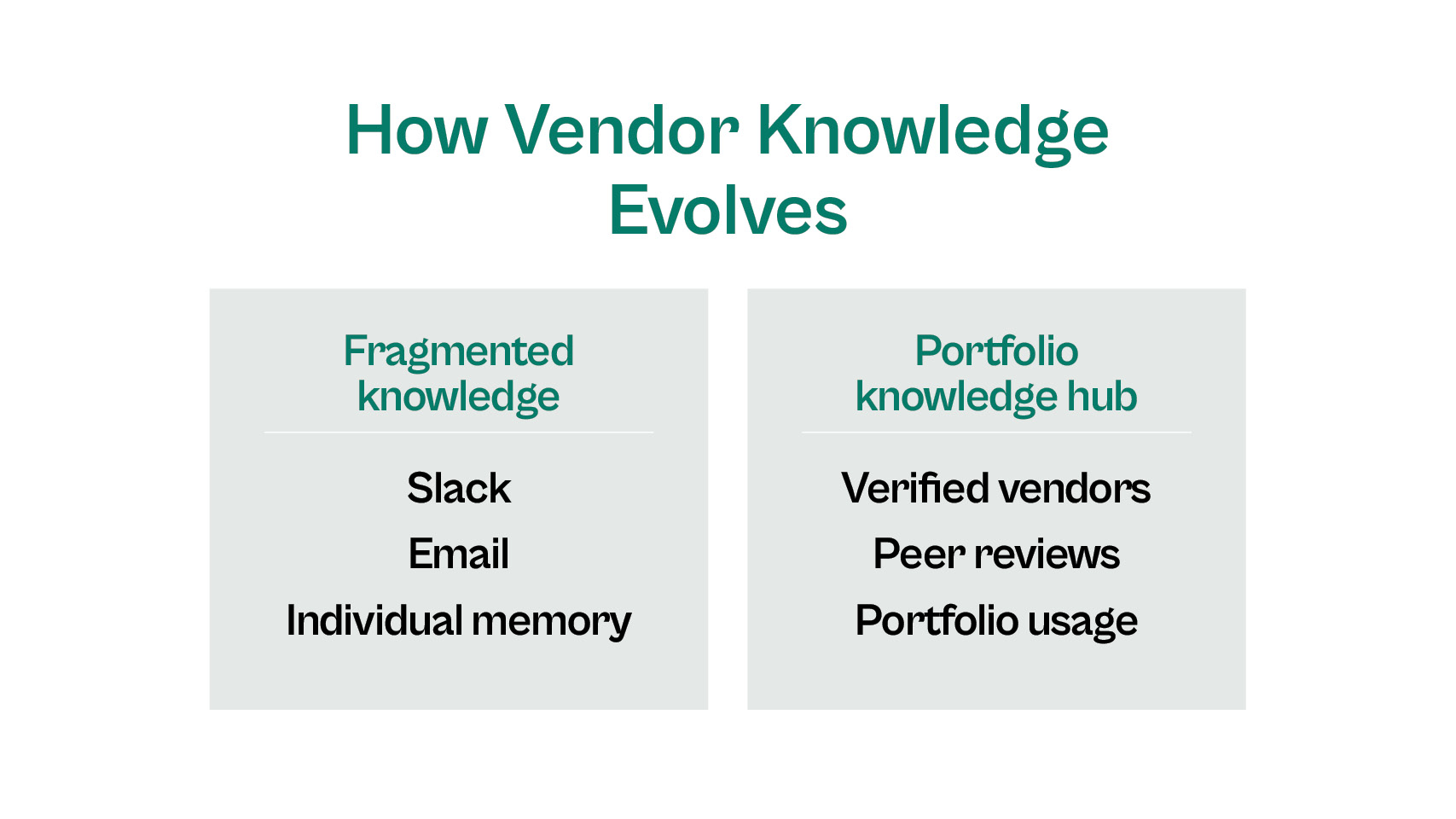
Vendor infrastructure strengthens the fund narrative
Institutionalizing vendor management also changes how a VC firm talks about its platform internally and externally.
When vendor activity is centralized and visible, platform impact is no longer anecdotal. Instead of saying “we helped companies negotiate better deals,” platform teams can point to actual cost savings across portfolio companies. Finance teams gain clearer visibility into vendor payments and expense tracking, which makes it easier to align operational spending with fund-level reporting requirements.
That clarity compounds over time. Platform leaders can link vendor performance to operational efficiency across the portfolio, and GPs can speak with far more confidence about platform value when discussing fund operations with LPs. The conversation shifts from stories about support to measurable operational outcomes.
Once vendor data and performance metrics are structured this way, vendor management stops feeling like an operational side project. It becomes part of the firm’s operating model. And increasingly, that operating model influences how venture capital firms compete for investment opportunities.
One thing to remember is that founders today evaluate more than just capital. They look at the infrastructure surrounding the fund: how quickly portfolio companies can access trusted vendors, how easily they can make informed decisions, and whether the platform team provides clear operational guidance.
A centralized vendor management platform that strengthens vendor relationships and simplifies vendor onboarding can become part of that differentiation.
What Institutional Vendor Management Looks Like in Practice
The easiest way to spot a mature platform team is how quickly they can answer vendor questions.
If a founder asks about a marketing agency, accounting software, or infrastructure provider, the team doesn’t need to ask around or reconstruct context. They already know which vendors are used across the portfolio, how those relationships have performed, and where companies have run into issues before.
That level of visibility doesn’t happen by accident. It comes from treating vendor management as portfolio infrastructure rather than a series of one-off introductions.
In firms where vendor infrastructure is institutionalized, vendor knowledge doesn’t live in individual inboxes or Slack threads anymore.
When a new portfolio company asks for help evaluating vendors, the team can immediately see which vendors other companies are already working with, how those relationships have evolved, and whether there are strategic partners that make sense to recommend. Instead of rebuilding context every time, they’re working from a growing body of vendor data that reflects real usage across the portfolio.
Platform leaders can see which vendors consistently perform well, which tools are gaining adoption across companies, and where vendor relationships might be creating risk or unnecessary cost. Instead of reacting to vendor requests in isolation, they can guide vendor selection with context that reflects the portfolio as a whole.
The result is that founders can effortlessly choose the vendors that match their business needs with greater confidence, and platform teams can facilitate faster growth while avoiding mistakes other founders in the portfolio have already encountered.
That’s the real shift behind institutional vendor management. It turns fragmented vendor knowledge into shared infrastructure and knowledge, something every company in the portfolio can benefit from without adding friction to how they operate.

Where This Trend Is Headed
As venture capital continues to professionalize, operational infrastructure is becoming just as important as financial strategy. Platform teams are no longer judged solely on introductions or ad hoc support. Increasingly, their role is to build systems that help portfolio companies make better decisions faster.
Vendor infrastructure is part of that shift. But the next phase goes beyond simply centralizing vendor data or organizing vendor relationships.
What’s emerging now is something closer to a portfolio knowledge hub.
In an environment where AI-generated content can make any vendor look credible (polished websites, glowing case studies, even fabricated reviews), external signals are becoming harder to trust. Founders evaluating vendors today are often navigating a flood of information that is difficult to verify.
That’s where portfolio ecosystems start to matter more.
When founders can see which vendors other portfolio companies are actually using, how those relationships performed, and what peers would recommend, vendor decisions become grounded in real outcomes rather than marketing claims. Human-to-human signal becomes more valuable than algorithmic rankings.
For platform teams, this doesn’t mean adding another layer of manual oversight. When vendor knowledge is structured inside a centralized system with verified vendors, peer feedback, and shared usage patterns, those signals compound naturally. Each engagement adds to the portfolio’s collective intelligence.
Over time, the firm builds something much more powerful than a vendor directory. It builds a trusted internal ecosystem where founders can access vetted partners, learn from each other’s experiences, and move faster with greater confidence.
The venture firms that invest in this kind of knowledge infrastructure are not just organizing vendors. They are creating a durable advantage: a portfolio network where trust, experience, and operational insight accumulate year after year.
And in a VC environment increasingly shaped by automation and artificial intelligence, that kind of human signal may become one of the most valuable assets a platform team can build. Looking for a streamlined solution for your portcos? See how Proven can help.